Tuesday, March 06, 2012

Contemplative Nuns Called to Community

Living the Life: 
Romanticism vs.
On-going Conversion 

Recently there was some interesting discussion on one of my favorite websites, A Nun’s Life. Two IHMs (Sister Servants of the Immaculate Heart of Mary, Monroe, MI), Sisters Julie and Maxine are hosts for regular podcasts, fielding all sorts of questions posed by those considering a vocation in religious life. They respond with a unique combination of humor, wisdom and experience. During a podcast (7pm daily EST) a question was asked which I will reword from memory. “I see a lot of vocation websites put up by communities and other kinds of publicity for congregations and all the faces are smiling and the message is given that religious life is a lot of fun. Is it really always fun? And I hear lots of talk about the aura of holiness. Is all of this realistic? Isn’t there any downside?” Sr. Julie responded by discussing what she called a romanticism about religious life and nuns in particular. There is a good bit of misinformation or misimpression out there. Reality checks are sorely needed.

I hear a great deal of a kind of romanticism about cloistered contemplative life from those who make inquiry with our community regarding vocation discernment. I hear it from young and old. Most, unfortunately, have not explored their call with a good spiritual director and most have never visited a monastery! In other words, they have no way of making a reality check. Often they seem to have two huge misconceptions. First is the idea that they can come to a monastery and pray all day. Yes, we do pray a great deal both together and in private but we must also engage in all the necessary household tasks as well as contribute effort to the remunerative work that supports the community. These activities require a degree of community interaction.

The second misconception is that the personal sacrifice will chiefly consist in withdrawal from secular society and the development self-discipline necessary for all the devotional practices in which they will be free to engage (Liturgy of the Hours, Mass, Adoration, Rosary, etc., etc.). However, in all likelihood, the greatest sacrifice to be asked of them will be a necessary surrender of the ego in order to be transformed in Christ. Surrender of the ego; that is our penchant for control, our need to plan, the selfish desires and satisfactions to which we have become so accustomed, is required by a life in which personal autonomy is narrowed and needs, desires, preferences, and ways of doing things must always take others into consideration. Community life, interaction with individuals, is where the ‘rubber hits the road’. The choice to enter religious life is not only a choice for deeper spirituality and dedicated mission. It is, perhaps above all, a choice in favor of community, the choice to live in a group of people one might never have considered as possible friends. And in contemplative life, that group is together 24/7.

Discerners seem to understand the components of prayer and mission but rarely have any idea of what is implied by the choice for the third leg of the stool of religious life, the choice in favor of community. Because the legs of prayer and mission still allow for a good bit of personal control they do not test the ego as much as the leg that is community life. In his workshop “Intentional Community”, Marist Brother Donald Bisson, FMS (spirituality and Jungian psychology) declared, “The main task of adjustment to living in community will be shadow work.” By shadow is meant the aspects of our psyches and personalities that we hide away consciously or unconsciously because we would not want others to see them. Held in our shadow are the psychic wounds which often determine our behavior and the ego needs we cover up in polite society – control, perfectionism, insecurity, fear, etc., etc.

It is said that the choice for religious life is an expression of the desire for God, the desire to be a God seeker. The closer we come to God the more we are asked to become like God. To seek God is to consent to be transformed into God, to submit, to surrender to the process of interior conversion. And there is no better laboratory for the conversion of our egoic selves than that of community living. Spiritual devotion prepares the way. Mission gives expression to our commitment to service in the name of Jesus. However, only living in community will challenge and stretch what is hidden in the shadows, rub the wounds, and jostle the baggage we carry. 
I have met a few of those young happy faces in cloistered and apostolic communities. In many their joy is transparent and the rightness of their choice confirmed. In others I read pressure, nervousness, and stress. In any close human community interpersonal life is intense and demanding. This is not to say that the process is not good or not transformative or not a necessary part of our personal conversion process. All of that is real and true but most do not seem to see it that way at the beginning.

One of the Psalms declares that wherever people live as one it is like the blessing of “oil flowing down Aaron’s beard”. Community life is blessing. In community we experience “union of hearts and mutual charity”. We experience support, mentoring, friendship and the pleasure of sharing. We rejoice, celebrate, worship, suffer and grieve together. Truly, ‘many hands make light work’. Above, all we bond in our love for God and the endless journey of seekers. But we must also make decisions together; take into account our cultural and ethnic variety; and transcend our differences. The old must adapt to the young and the young must be compassionate toward the old because the new comers always ask, “Why do you do it this way?” and the old always respond, “We have always done it this way.”

Community life is the arena of transformation in which the God seeker can live in ever deepening participation in the life, death and resurrection of Jesus Christ, the Paschal Mystery of our salvation and grow in likeness to the one whom we call our Beloved.

Resource: “Intentional Community” Brother Donald Bisson, FMS (2 CDs) Workshop Sries #49 – YesNowMusic.com or YesNowMusic@aol.com or google Don Bisson.

Thursday, February 09, 2012

Contemplative Nuns to Meet in Rome

Or....As If the Esopus Redemptoristines
Didn't Already Have
Enough on Their Plate!

The process of arranging for our move to a new location late in May goes on and on. Can't wait until we can unveil the whole plan. But now the lawyers are writing the purchase agreement, the finances are being contemplated and contractors are readying their bids. Each day more loose ends appear which we try to tie up as soon as possible. Stay tuned for further installments of the saga. And keep on praying.

For over a year, as all of this 'shock and awe' was transpiring locally, we have also been participating in preparations for a General Assembly of our international community, the Order of the Most Holy Redeemer. Since we are a contemplative order we do not have a general government riding herd over all the monasteries of the Order. Each contemplative monastery is autonomous as is the case with Carmelites, Poor Clares, etc. Autonomous monasteries may organize themselves into federations but these federation do not have real legal (juridical authority). 

It is a fortunate conincidence that earlier this week Sr. Julie Viera at the interactive blog "A Nun's Life" (highly recommended) described the recent General Chapter of her congregation, Sister Servants of the Immaculate Heart of Mary (IHMs of Monroe, MI). One of the IHM founders was a Redemptorist so we have some roots in common. Note the difference of meeting title. The IHMs had a General Chapter and the Redemptoristines are going to have a General Assembly. There is a big difference between them. Here are Sr. Julie's words about their Chapter:

Although Chapter is part and parcel of our life as Catholic sisters and nuns today, it might seem like a secret event veiled in mystery for those outside of religious life! So, here’s a bit more about what Chapter is. I am drawing here from my brother Redemptorists who provide a great intro on General Chapter.

"The General Chapter is a visible expression of a fundamental sense of democracy that lies at the heart of religious life. This democracy is based on the radical equality of all the members by virtue of their baptism and their religious consecration, hence their common vocation to be prophets or spokespersons for God. In this sense, a General Chapter resembles more the gathering of Mary and the apostles at Pentecost than a modern parliament or congress. The participants in the General Chapter gather in the name of Jesus Christ, confident that his Spirit will help us to accomplish our work.

What are those tasks? The General Chapter must first take an honest look at the state of the Congregation… This examination should then lead the Chapter members to face honestly certain discomforting questions: are we faithful to our mission or have we slid into mediocrity? What is the Lord asking of us today? How are we being asked to change? The General Chapter will offer specific directives for the whole Congregation as it proposes a path to help [religious] live more authentically their … vocation. Finally, the delegates will elect the leadership of the Congregation for the next six years … "(Source - http://www.cssr.com/)
For our IHM General Chapter, we had a gathering of over 150 IHM Sisters and were joined for some parts of Chapter by our IHM Associates and others who could be of great help in our discernment and decision-making. One of the best parts was that we come together from across the globe, across ministries, across generations, across cultures and gather under one roof. It was a visible expression of the community we experience with one another every day of our religious life no matter where we are.

The Redemptoristine General Assembly will have exactly the same goals and function as the IHM General Chapter and the Redemptorist General Chapter as described here. However, a General Assembly does not have the same level of authority according to Canon Law. In a congregation such as the IHMs a Chapter is composed of all the professed sisters in its various houses and ministries. In a contemplative order a Chapter is composed of all the solemnly professed nuns in that particular monastery. When we have a community meeting atteneded by only the nuns in solemn vows we are having a Chapter meeting. Chapters elect leadership, approve or reject requests for vows and provide consultation for the superior.  A General Assembly does not elect leadership because, unlike a congregation, an order does not have a general government. Our Prioress, the elected superior has the same level of authority within our monastery as a major superior (mother general or father general).  This makes the fairness of monastery elections absolutely vital so by Canon Law those elections must be supervised by the local ordinary or his representative and the accuracy of the vote count attested to by 'scrutineers'. 

Nonetheless, our General Assembly will be an opportunity for Redemptoristines to "come together from across the globe, across ministries, across generations, across cultures and gather under one roof." The Assembly, its deliberations and discussions, the personal interaction afforded by the gathering will contribute to unity and energy for the apostolic work of the Order. But monastic autonomy will continue to defend the right of each monastery to interpret the Assembly's directives as suggestions subject to their own house statutes. However, a General Assembly, can by agreement, approve and adopt a RULE, the Constitution and Statutes, that will be used a  rule of life throughout the Order.

So much for the arcane features of Church law. Bottom line is that each meeting, at whatever, level, with whatever degree of authority, is at the service of the charism of that particular religious family according to the inspiration of the Holy Spirit and in the spirit of the Gospel  love of Jesus Christ.

Sunday, January 15, 2012

Settling into Ordinary Time

Here it is, the second Sunday in Ordinary Time. This is a 'skinny' season between Christmas and Lent. Ash Wednesday comes on the 22nd of February this year. Seems just a bit of a breather. But it really can be process time, opportunity to process, to sit with, to fully take in the deep, deep mystery of the Incarnation. There are no cards to write, no presents to buy, no trees to decorate. There is just an in between time, a time to 'be with'. Things even seem to slow down on the social scene in these months. Why not take advantage of it and and carve out a bit of retreat time - an hour, a day, a weekend. An opportunity is being offered. It is like the call to Samuel in today's first reading. Why not respond, "Speak Lord, your servant is listening."

And another matter:

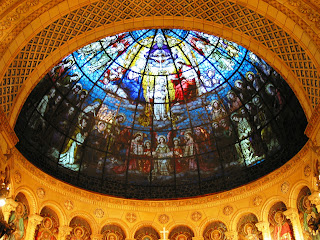
These days we have been watching the dismantling of Mount St. Alphonsus. It is a 400 acre property dominated by a massive former seminary built in 1911. For three generations it has been a constant presence in the Hudson River Valley. For years the students taught Religious Education classes in local parishes. For years the professors fanned out every Sunday to celebrated Masses throughtout the county, bringing their particular Redemptorist approach to preaching and liturgy. Since 1987, it has been a retreat center drawing New Yorkers as well as folks from New Jersey, Connecticut and Massachusetts. This week does truly mark the end of an era.


Stained glass dome in chapel
For us these days are filled to overflowing with continuing preparations for our relocation to a new monastery - not a new building but a new location. We are not able to share the details at this time but do that know we are moving ahead. We are so grateful for the support of the Redemptorists and our many friends. We are also grateful to have met so many others along the way who have been so helpf
Please continue to pray for us, that the gifts of the Holy Spirit of Wisdom and Counsel will be with us as we proceed. Please also pray for ourt community elections set for January 26th.

Friday, January 13, 2012

Mystery of the Hummel Figurine

On December 27, 2011 I posted a piece about our Redemptoristine tradition of displaying the infant Jesus in many places in the monastery - some as big as a baby doll and some as small as this 5" Hummel figure. I told the story of how I received it as a gift over 50 years ago and have long wondered about its origin and value. Someone else, googling around to find out about their similiar baby  Jesus was brought to this blog and sent the following:

I was searching "google" for information about my bisque Hummel Infant Jesus and your Blog came up.  Because you told how you acquired your Infant Jesus, I'll tell you how I acquired mine.

My Hummel is exactly like yours, but mine is the "large" figurine -- it's about 11.5" long.  I bought it in the fall of 1953 through my German teacher at Mundelein College, Chicago, a darling little German nun (BVM) whose name I now forget, but it probably is in my "year book", if I could ever locate that after all this time.   She was well acquainted with Berta Hummel's religious order and had an arrangement to purchase the "Infants" at cost -- both the small one ($3 I think) and the large one ($6, as I remember).  Most of my classmates who bought one, bought the small one.  But I (and possibly one other student) bought the large one -- mine was my Christmas gift to my Mother -- so I needed to be generous.  She displayed it with her Christmas decorations every year.

Following my mother's death about 6 years later, I reclaimed the Infant Jesus and have displayed it with my Christmas decorations since.  It has survived the move from Chicago to Iowa to California, earthquakes, and 5 kids.  I used to hang it above the fireplace, but now I display it on the mantel in a woven oval basket filled with gold-colored garlands, rolled up, to make a "bed of straw." 

My figurine has the name "Hummel," and the "v" and "bee" stamped on it, indicating that it was made between 1950 and 1955.  It also has the numerals: 78/6 on the back -- I have no idea what this means.  It's the same light beige coloring, and has the two holes in back, as yours.  I have a memory (which I no longer trust) that my German teacher said that Berta Hummel never made any figurines, except this one of the Infant Jesus -- as all her other works were drawings (and the typical figurines were made by other artists, based on her drawings).  The Infant Jesus figurines, which you and I have, are (supposedly) made from molds of the original work of Berta Hummel.

Many thanks,

Also, I have no idea of the value of your Infant Jesus, or mine.  My one "google" search was fruitless in this regard.  But, I know that mine is as "priceless" to me as yours is to you.

Thank you for your Blog, and wishing you God's blessings in this New Year.

NCV

This correspondence got me searching again and came up with this. Here's the link:
www.tace.com/i/35663.html I found a complete description of my small Jesus and a perfect picture. It was made between 1952-1959. Unfortuantely no value was given because the item was sold off line. 

Perhaps this bit of research and exchange of memories will excite those who collect Hummels and prompt them to to share stories and information.


Sunday, January 08, 2012

Remember the Call - Vocation Awareness Week

Because we believe in the endless invitation of God, we remain convinced that many women and men are called to enter into deeper relationship with the Divine. We believe that this interior prompting  to remove oneself to an environment tailored to support the search for God is still observed in all the major religious traditions and across cultural lines. However, so many today, while sensing a nagging pull deep within, sensing a persistent desire, do not know where to go. Catholic education and culture today do not provide the information and exposure that would bring them to consideration of religious vocation in the Church.

Contemplatives, although the very life they wish to offer is a remove from the usual involvement in society, must make an effort to reveal their way of life, the search for God it offers, and the opportunity it presents for personal conversion which is transformation in Christ. For Redemptoristines it is the path to becoming a "Living Memory" of Jesus Christ", the inspiration of our foundress Maria Celeste Crostarosa. This blog, our Facebook Page, our website are efforts to invite and to educate.

The following remarks made to consecrated religious by Pope John Paul II are a reminder for us to reconsider our first call. They can also be an invitation to those who today are themselves experiencing the initial inspiration. 

As you renew in your hearts your act of profession, recall to mind that interior inspiration of the Spirit which originally led you to set out on this way to God.

Recall the circumstances of this inspiration, how it became more and more insistant, possibly returning after a time, until you could not fail to recognize in it the voice of God, the force of love with which the Lord calls a person to belong to Him undividedly.

Recall this to mind, in order to thank God with a new heart and to proclaim His mighty works. That inspiration of the Spirit cannot die out. It is destined to endure and, together with your religious vocation, to become more mature throughout your entire lives.

During this week of Vocation Awareness think of your own vocation; help us educate the People of God about the nature of this life; pray for the effort. AND, if you know someone seriously pursuing the spiritual way, why not mention religious life to them and encourage them along the way?