Friday, April 06, 2012

An Urban Saint

In the Arms of God

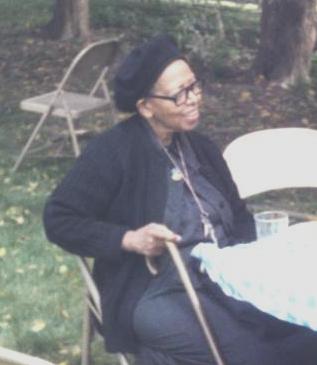
There used to be a feature in the Reader's Digest entitled "The Most Unforgetable Character I Ever Met". Today I learned of the death early this morning, early on Good Friday, of one of my most unforgetable characters.  Betty had a most memorable character. For over ten years I brought Holy Communion to her on Sunday mornings. I'd been ask to take this on by a close friend of mine who had already been bringing Communion to Betty for many years, always on Tuesday mornings and always along with fresh fruit and vegetables. My friend continued to do this for many more years. My appointments with Betty ended with my entrance into the monastery.

There is so much more I want to say about Betty. However, at this time, by way of introduction, I post the obituary I wrote long ago and put aside for this day. It is great comfort to me that this wise woman, always close to the Lord, is now whispering compassionate pleas while in the embrace of her Beloved.

Athalie “Betty” Elizabeth Wimbish


c. 1950

Kingston, NY – Athalie Elizabeth Wimbish, well known to residents of uptown Kingston as a local presence particularly to shoppers at London’s clothing store on North Front Street in Kingston where she was employed from the early 1940s to the late 70s, died at Ferncliff Nursing Home on Good Friday, April 6 at the age of 95.

She was born on August 4, 1916 at
100 Gage Street, Kingston
, the daughter of Andrew and Blanch Elizabeth Wimbish and grand-daughter of Hannah “Hattie” Elizabeth Jackson. She proudly spoke of the African-American and Mohawk heritage received from her father and mother and the Dutch cultural influence of her maternal grandmother. She graduated from Kingston High School in 1934. There she wrote interviews for “Dame Rumor” and played basketball. The year book indicated that she was college bound and spoke of missionary work in Africa.

Kingston High School
Her childhood was spent in
Albany Avenue
mansions where her grandmother served as housekeeper. One employer was the owner of the Fuller Shirt Factory. In these settings and as a precocious child of mixed race she was exposed to a variety of educational influences. Her grandmother provided religious formation at both St. John’s Episcopal Church on
Albany Avenue
and the AME Zion Church on
Franklin Street
.

In the late 1930s Betty Wimbish experienced the excitement of the Harlem Renaissance and her first trip to Europe. She returned to Kingston to care for her mother and grandmother, working first at Montgomery Wards where her mother was the elevator operator. Beginning in 1943, she fulfilled many tasks for London’s, including inventory, accounts receivable, shipping aid packages to Stanley London’s relatives in Europe and secretarial assistance to Mrs. London who was President of Hadassah, a Jewish organization for women.

First attracted to the Catholic faith during her time in New York City, she was received into the Church in the 1950s at St. Mary’s Church in Kingston which was very welcoming to people of color. After being rejected in an effort to become a Catholic sister due to her race, she made a decision to serve the Church in every other way possible; catechist at St. Mary’s; prayer support to any number of priests including Rev. Daniel Egan known as the “Junkie Priest”; ecumenical efforts in concert with the Franciscan Friars of the Atonement at Graymoor, Garrison, NY, and fund-raising for overseas missions.  She was a member of a world-wide mission tour in 1965 which included stops in Hawaii, Japan, India and the Holy Land. In India she sat on the dais during Mass celebrated by Pope Paul VI.

1990
Around the time of her conversion to Catholicism Ms. Wimbish made a life choice, a preference for personal poverty and simplicity motivated by her deep faith and supported by an active spiritual life. By the 1970s she had assumed this persona to such a degree that she became known only as “Black Betty”, dressed always in black with a kerchief or beret covering her head at all times. She was readily recognized on uptown streets as she walked to and from daily Mass at St. Joseph’s Church and on to work. For more recent arrivals to town she merely seemed to be a local character, the woman in black who swept the floors at London’s clothing store.

After retirement in 1976, she became an urban hermit, praying constantly, serving as confidant and aide to the poor and as a conduit of funds she received from more fortunate friends. Agnes Scott Smith, who taught Athalie Wimbish at Kingston High School, now deceased, described her as “quietly pious, an enigma who became a nun without going into the convent.”

Athalie Elizabeth Wimbish is survived by a nephew Sherwood Harvey and his wife Venice and one grand nephew who were devoted to her care during these last years. She is also survived by her friends Mary Cicale and Sr. Hildegard Pleva, OSsR, her spiritual sisters who cherish memories of her wisdom and holiness They are forever marked by her influence.

Tuesday, April 03, 2012

Contemplative Nuns Relocate

Announcing Our Move:
The Story of Our Process
and Our Hopes for the Future

It has seemed an extraordinarily long time in coming. We are grateful for the support, patience and advice offered to us by so many. We are particularly grateful to our Redemptorist brothers who have so generously contributed to our ability to move into our own home.

With the help of God we will move to
4 Jersey Street
in East Rutherford, New Jersey during the last week of May. This urban residential location may appear to be a very surprising choice. Some background for our decision-making in this regard can be reviewed in an article posted to this blog a few months back, “Monastic Architecture: The Household of God”.

We learned just one year ago that we would have to move from Mount St. Alphonsus. The search began. The list of our particular needs was great; among them many factors which do not figure into the considerations of a regular family.

The monastic pilgrim travels two inseparable parallel paths in a journey of self-abandonment and interior transformation into Christ; the way of prayer and the avenue that is life in community. Within the enclosure created to support and protect a life of intensive intimacy with God and intensity of relationship with a stable group, all of the functions of the monastic household are carried out twenty four hours a day, seven days a week within a fixed group of members. Unlike the nuclear family or the small group of apostolic religious living together, the contemplative monastic residence must have room for everyone to do everything together most of the time. No members will be off to a ball game or have a late night at the office. No one will go out to work. No one can arrive home after a long hard day and announce their departure to take in dinner and movie with a friend. These realities determine architectural form. The dining room and community room (living room) have to be larger than one might expect. Anyone whose work for the community requires a private office space has to have one within the confines of the monastery. The income generating work of the community, whatever it may be, will call for considerable space, the equivalent of a small manufacturing enterprise including materials storage, assembly, shipping, ordering, etc. All of the members of the community will share the work of maintaining the household. Cooking, cleaning, communication, greeting and housing guests, and scheduling, to name a few typical household tasks, also affect the need for space within the enclosure. In addition, just as the nuclear family has a role in educating its young members so does the monastic family. Like any good parent, the monastic community seeks to provide sufficient resources as well space for instruction and study to equip and inspire new members for the life they have chosen. Monastic structures are designed to provide for both this intensive life in community and the solitary search for God which is the vocation of each member.  

In addition to these considerations was the desire to have daily Mass in our own chapel (something many contemplative communities are doing without), handicapped accessibility, building condition, supportive surrounding community.

In our process we personally inspected many sites and thoroughly investigated others via the Internet and lengthy phone conversations with realtors. We walked through private homes, a bed and breakfast inn, a former mansion built by one of the Ringling brothers, former novitiates and retreat houses and cast our net as far as West Virginia.

Last October we received a call from a young priest at Most Sacred Heart Church in Wallington, NJ. His godmother is a friend of our community and she had appealed to him to call us because the church’s former convent (sold in 1983 to the Franciscan friars) was on the market. He offered a rundown more complete than any realtor’s. And we were off.

Built in 1963, this unusually large parish convent has never been empty or neglected. The Franciscans maintained it as a friary, development offices and headquarters for the St. Anthony Guild. As does any venerable building of the 1960s, it requires regular tender loving care and watchfulness. But sturdy it is and commodious. The property is long and narrow running from corner to corner on a short block. Directly across the street from the chapel end of the building on Paterson is Most Sacred Heart of Jesus Church in the town of Wallington which is the third largest concentration of Polish-Americans in the nation.

From the first floor entrance visitors will have access to two parlors, the chapel, a meeting room and a half bath. The enclosure on the first floor includes community room, prioress’ office, library, dining room, kitchen (newly modernized), walk-in pantry, a large bedroom with a private bath and two half baths, one handicapped accessible. At the rear, near the pantry is an exit to a ramp for the handicapped and access to a two-car unattached garage and drive way with parking room. Two sets of French doors lead from the public meeting room to a large raised concrete patio facing a small back yard. And the chapel – just the right size - exposed brick throughout with beautiful stained glass windows. There are two sacristy rooms.

The second floor has 11 bedrooms. Original small bedrooms were modified into five large rooms with private baths. There are three sets of small rooms with connecting doors and three single small rooms. None of these have private baths. However two bathrooms on the hall were recently remodeled, one totally handicapped accessible.

The basement offers a large sewing room for our cape department with a smaller room adjacent for storage and CSsR habit department. This level also includes space for archives and computers as well as a laundry room and half bath.

The adaptations already made to the building support our use and save us expense. However, there is much to be done: handicapped ramp to chapel in place of three shallow steps in the hall; modifications to first floor bedroom bath for accessibility and safety; painting; security system; dual burning furnace needs to be changed from oil to natural gas; bathtubs changed to showers in some bathrooms; more interior lighting for safety; and repair or replacement of existing chair lift to second floor and installation of another to the basement. And these are only the most immediate. We have a two-year plan, a five-year plan, etc. To achieve all of this, we have been working with an architect, building contractor, and countless other professionals.

Not only do these items carry a price tag but so does the house itself. In this regard we have received tremendous assistance from the Redemptorists. However, as first time home buyers, without any equity from a previous home sale, we have had to enter into the realm of home financing. In order to pay off this debt we will be launching a major fund-raising campaign. We have applied for and received grants for remodeling and handicapped adaptation but grants are not available to help with purchase loans! Therefore we will depend on the generosity of others and the small income we generate. To this end we are developing a new website. Its ‘home page’ is already up on the Internet and has a Pay Pal “Donate” button for those who feel comfortable making a contribution on-line. Here's the current link: http://www.redemptoristinenunsofnewyork.org/

What cannot be left out of the recommendations for this building is its location in the heart of an active Catholic community, its proximity to other Catholic parishes and also locations of Redemptorist missions. These factors increase the likelihood that we will be able to create a rotating schedule of priests willing to come to offer Mass in our chapel.
Perhaps we will have Mass at a time when parishes do not offer them so lay people will come to join us for Eucharist. We are also eager to re-establish our lay associate program and to offer occasions for spiritual enrichment in terms of contemplative life-style as well as spiritual direction.

We did not seek this move. However we have sought to see God’s invitation in it. We live in an era of change at every level. The People of God cry out for a spirituality of depth and meaning, for community, and for the need to be encouraged by those willing to witness to the love of Jesus Christ in the Church and the world. Religious life is in the throes yet again of coming to grips with the signs of the times and discerning how to respond, how to reconfigure in order to remain true to the mission. In all of this we seek to bring to fulfillment in a different time and a different place the eternal truth of Maria Celeste’s revelation to follow Christ, to be so united to Him, that we become “Living Memories” of Christ radiating the love of God the Father in the power of the Holy Spirit. Perhaps this is more necessary now than ever; when we are no longer surrounded by meadows and river but by the flow of God’s people inviting us into their pilgrim journey.  

Tuesday, March 06, 2012

An Inviting Reminder

Red Nuns on Facebook!

and More

Yes, our community now has its own Facebook Page. For Facebook participants just search for "Redemptoristine Nuns of Esopus".

But if you are not interested in being on Facebook you can still see our page as often as you wish by using this link:

Facebook.com/rednunsesopus

Messages (in FB talk called "status updates") are much shorter than posts to this blog and much more frequent. So to keep up with the progress of our big RELOCATION PROJECT  please do check out the page every now and then.

AND an new website for our community is under development. For a bit of a preview of its new look go to:

www.RedemptoristineNunsofNewYork.org

Clicking on the link will bring you to a 'landing' page from which you can enter our current site. The landing page also contains a "Donate" button which will enable a PayPal donation transaction for our Relocation Fund.


Contemplative Nuns Called to Community

Living the Life: 
Romanticism vs.
On-going Conversion 

Recently there was some interesting discussion on one of my favorite websites, A Nun’s Life. Two IHMs (Sister Servants of the Immaculate Heart of Mary, Monroe, MI), Sisters Julie and Maxine are hosts for regular podcasts, fielding all sorts of questions posed by those considering a vocation in religious life. They respond with a unique combination of humor, wisdom and experience. During a podcast (7pm daily EST) a question was asked which I will reword from memory. “I see a lot of vocation websites put up by communities and other kinds of publicity for congregations and all the faces are smiling and the message is given that religious life is a lot of fun. Is it really always fun? And I hear lots of talk about the aura of holiness. Is all of this realistic? Isn’t there any downside?” Sr. Julie responded by discussing what she called a romanticism about religious life and nuns in particular. There is a good bit of misinformation or misimpression out there. Reality checks are sorely needed.

I hear a great deal of a kind of romanticism about cloistered contemplative life from those who make inquiry with our community regarding vocation discernment. I hear it from young and old. Most, unfortunately, have not explored their call with a good spiritual director and most have never visited a monastery! In other words, they have no way of making a reality check. Often they seem to have two huge misconceptions. First is the idea that they can come to a monastery and pray all day. Yes, we do pray a great deal both together and in private but we must also engage in all the necessary household tasks as well as contribute effort to the remunerative work that supports the community. These activities require a degree of community interaction.

The second misconception is that the personal sacrifice will chiefly consist in withdrawal from secular society and the development self-discipline necessary for all the devotional practices in which they will be free to engage (Liturgy of the Hours, Mass, Adoration, Rosary, etc., etc.). However, in all likelihood, the greatest sacrifice to be asked of them will be a necessary surrender of the ego in order to be transformed in Christ. Surrender of the ego; that is our penchant for control, our need to plan, the selfish desires and satisfactions to which we have become so accustomed, is required by a life in which personal autonomy is narrowed and needs, desires, preferences, and ways of doing things must always take others into consideration. Community life, interaction with individuals, is where the ‘rubber hits the road’. The choice to enter religious life is not only a choice for deeper spirituality and dedicated mission. It is, perhaps above all, a choice in favor of community, the choice to live in a group of people one might never have considered as possible friends. And in contemplative life, that group is together 24/7.

Discerners seem to understand the components of prayer and mission but rarely have any idea of what is implied by the choice for the third leg of the stool of religious life, the choice in favor of community. Because the legs of prayer and mission still allow for a good bit of personal control they do not test the ego as much as the leg that is community life. In his workshop “Intentional Community”, Marist Brother Donald Bisson, FMS (spirituality and Jungian psychology) declared, “The main task of adjustment to living in community will be shadow work.” By shadow is meant the aspects of our psyches and personalities that we hide away consciously or unconsciously because we would not want others to see them. Held in our shadow are the psychic wounds which often determine our behavior and the ego needs we cover up in polite society – control, perfectionism, insecurity, fear, etc., etc.

It is said that the choice for religious life is an expression of the desire for God, the desire to be a God seeker. The closer we come to God the more we are asked to become like God. To seek God is to consent to be transformed into God, to submit, to surrender to the process of interior conversion. And there is no better laboratory for the conversion of our egoic selves than that of community living. Spiritual devotion prepares the way. Mission gives expression to our commitment to service in the name of Jesus. However, only living in community will challenge and stretch what is hidden in the shadows, rub the wounds, and jostle the baggage we carry. 
I have met a few of those young happy faces in cloistered and apostolic communities. In many their joy is transparent and the rightness of their choice confirmed. In others I read pressure, nervousness, and stress. In any close human community interpersonal life is intense and demanding. This is not to say that the process is not good or not transformative or not a necessary part of our personal conversion process. All of that is real and true but most do not seem to see it that way at the beginning.

One of the Psalms declares that wherever people live as one it is like the blessing of “oil flowing down Aaron’s beard”. Community life is blessing. In community we experience “union of hearts and mutual charity”. We experience support, mentoring, friendship and the pleasure of sharing. We rejoice, celebrate, worship, suffer and grieve together. Truly, ‘many hands make light work’. Above, all we bond in our love for God and the endless journey of seekers. But we must also make decisions together; take into account our cultural and ethnic variety; and transcend our differences. The old must adapt to the young and the young must be compassionate toward the old because the new comers always ask, “Why do you do it this way?” and the old always respond, “We have always done it this way.”

Community life is the arena of transformation in which the God seeker can live in ever deepening participation in the life, death and resurrection of Jesus Christ, the Paschal Mystery of our salvation and grow in likeness to the one whom we call our Beloved.

Resource: “Intentional Community” Brother Donald Bisson, FMS (2 CDs) Workshop Sries #49 – YesNowMusic.com or YesNowMusic@aol.com or google Don Bisson.

Thursday, February 09, 2012

Contemplative Nuns to Meet in Rome

Or....As If the Esopus Redemptoristines
Didn't Already Have
Enough on Their Plate!

The process of arranging for our move to a new location late in May goes on and on. Can't wait until we can unveil the whole plan. But now the lawyers are writing the purchase agreement, the finances are being contemplated and contractors are readying their bids. Each day more loose ends appear which we try to tie up as soon as possible. Stay tuned for further installments of the saga. And keep on praying.

For over a year, as all of this 'shock and awe' was transpiring locally, we have also been participating in preparations for a General Assembly of our international community, the Order of the Most Holy Redeemer. Since we are a contemplative order we do not have a general government riding herd over all the monasteries of the Order. Each contemplative monastery is autonomous as is the case with Carmelites, Poor Clares, etc. Autonomous monasteries may organize themselves into federations but these federation do not have real legal (juridical authority). 

It is a fortunate conincidence that earlier this week Sr. Julie Viera at the interactive blog "A Nun's Life" (highly recommended) described the recent General Chapter of her congregation, Sister Servants of the Immaculate Heart of Mary (IHMs of Monroe, MI). One of the IHM founders was a Redemptorist so we have some roots in common. Note the difference of meeting title. The IHMs had a General Chapter and the Redemptoristines are going to have a General Assembly. There is a big difference between them. Here are Sr. Julie's words about their Chapter:

Although Chapter is part and parcel of our life as Catholic sisters and nuns today, it might seem like a secret event veiled in mystery for those outside of religious life! So, here’s a bit more about what Chapter is. I am drawing here from my brother Redemptorists who provide a great intro on General Chapter.

"The General Chapter is a visible expression of a fundamental sense of democracy that lies at the heart of religious life. This democracy is based on the radical equality of all the members by virtue of their baptism and their religious consecration, hence their common vocation to be prophets or spokespersons for God. In this sense, a General Chapter resembles more the gathering of Mary and the apostles at Pentecost than a modern parliament or congress. The participants in the General Chapter gather in the name of Jesus Christ, confident that his Spirit will help us to accomplish our work.

What are those tasks? The General Chapter must first take an honest look at the state of the Congregation… This examination should then lead the Chapter members to face honestly certain discomforting questions: are we faithful to our mission or have we slid into mediocrity? What is the Lord asking of us today? How are we being asked to change? The General Chapter will offer specific directives for the whole Congregation as it proposes a path to help [religious] live more authentically their … vocation. Finally, the delegates will elect the leadership of the Congregation for the next six years … "(Source - http://www.cssr.com/)
For our IHM General Chapter, we had a gathering of over 150 IHM Sisters and were joined for some parts of Chapter by our IHM Associates and others who could be of great help in our discernment and decision-making. One of the best parts was that we come together from across the globe, across ministries, across generations, across cultures and gather under one roof. It was a visible expression of the community we experience with one another every day of our religious life no matter where we are.

The Redemptoristine General Assembly will have exactly the same goals and function as the IHM General Chapter and the Redemptorist General Chapter as described here. However, a General Assembly does not have the same level of authority according to Canon Law. In a congregation such as the IHMs a Chapter is composed of all the professed sisters in its various houses and ministries. In a contemplative order a Chapter is composed of all the solemnly professed nuns in that particular monastery. When we have a community meeting atteneded by only the nuns in solemn vows we are having a Chapter meeting. Chapters elect leadership, approve or reject requests for vows and provide consultation for the superior.  A General Assembly does not elect leadership because, unlike a congregation, an order does not have a general government. Our Prioress, the elected superior has the same level of authority within our monastery as a major superior (mother general or father general).  This makes the fairness of monastery elections absolutely vital so by Canon Law those elections must be supervised by the local ordinary or his representative and the accuracy of the vote count attested to by 'scrutineers'. 

Nonetheless, our General Assembly will be an opportunity for Redemptoristines to "come together from across the globe, across ministries, across generations, across cultures and gather under one roof." The Assembly, its deliberations and discussions, the personal interaction afforded by the gathering will contribute to unity and energy for the apostolic work of the Order. But monastic autonomy will continue to defend the right of each monastery to interpret the Assembly's directives as suggestions subject to their own house statutes. However, a General Assembly, can by agreement, approve and adopt a RULE, the Constitution and Statutes, that will be used a  rule of life throughout the Order.

So much for the arcane features of Church law. Bottom line is that each meeting, at whatever, level, with whatever degree of authority, is at the service of the charism of that particular religious family according to the inspiration of the Holy Spirit and in the spirit of the Gospel  love of Jesus Christ.