Showing posts with label Grief. Show all posts

Sunday, November 02, 2014

All Souls' Day Reflection

 
A Gift of Presence
for the Digital Age
 
Reflection presented at
All Soul's Day Prayer Service Concert
St. Joseph's Church, Kingston, NY
11/2/14


We have so much in common today. We have all come to remember and celebrate those who have gone before us. Although we come in different stages of grief, with different flavors of remembering, our interior questions are probably quite similar. “How can I handle this? Where do I go from here?” The fortunate among us may have had a wise soul or a spiritual guide offering a willing ear. These treasures, like my spiritual director, share our sorrow and tears. They remind us that Jesus who wept at the death of his friend Lazarus is a companion in our sadness and grief. But then my spiritual director, as all good directors should do, asked the big questions. “And what is God saying to you in all of this? What opportunity is God asking you to find in your grief?”
          Bereavement is an experience of the loss of a presence in our lives; a presence that may have been influential, someone involved in our lives, available and responsive. However, it is also possible that we are grieving not only the loss of a person but also regretting the opportunities we missed to enhance our relationship with that person while still alive.
          Since we experience so keenly now the absence of a presence in our lives; since we may regret lost opportunities to be present, to be in meaningful relationship with the one who is gone; could it be that our loving God is inviting us to a new awareness of the quality of our own presence in the lives of others? Can this invitation be translated into a quality of presence that makes us better listeners, more generous with our time, more compassionate in response, and much less the masterful know it all problem-solver?
          Jesus was generous with his presence, so generous that he had time to see, really see people, even to seeing into their hearts. While in the midst of crowds he was attentive and he noticed. He noticed the tax collector Matthew bent over his coins. He noticed Zachaeus who had scrambled up a tree to get a better view. In both he saw a generosity of heart invisible to others. He felt the hand of the sick woman touch his cloak in the press of the crowd; stopped his forward momentum and took the time to praise her faith and provide the cure she sought. And when an unnamed woman approached him during a feast at Bethany he accepted her gestures of devotion even when others objected. He allowed her to anoint his body with fragrant perfume and with his words memorialized forever the depth of her love.
Speaking of feasts – the Gospels indicate that Jesus liked dinning with his friends. He liked to linger at table, hearing their questions and responding to them with homey yet instructive stories. His presence was gift.
          As Christians we are asked to imitate Jesus in all things. In our sense of loss is a seed, the seed for growth in Jesus’ quality of attentiveness to others. It is an invitation to grow into a more radical form of personal availability, of listening, of presence than has been our ordinary habit. This is a contemplative attitude toward relationship. It is a Jesus attitude. It also happens to be a very timely antidote to an explosion of communication without depth or feeling experienced this digital age. We find ourselves participating in a frenzy of communication. I am as guilty as anyone – busily at work as webmaster, Facebook page organizer, blog poster, e-mail user and most recently trying to master the I-Phone.  I would not give them up. These digital tools can be used to spread the Gospel Word, to work more efficiently, to just keep in touch. But texts, e-mail, tweets, blogs and Instagrams cannot provide an arm around the shoulder, a listening ear, a gift of quality time in family or with friends. Digital communication does not allow for reading the expression on a face, the tremor in the voice, or the body language that speaks in silence. This is the very quality of the one on one human presence, face to face, in the now that we miss in grief for our loved one and what we may wishing we had offered in the past.
          Consider the invitation that God may have wrapped up in your loss. Consider the invitation to a more loving quality of attention, awareness, and availability in all of your daily interactions. These may come at the kitchen table, in the line at the supermarket, at the next soccer game, or when all you hear is the sound of the TV and everyone’s head is bent over one device or another. It is a very timely appeal in our current technological age. This is the stuff of which our spiritual lives are made. Our response may be the finest tribute we offer in memory of our loved one, the quality of whose presence made such a difference in our life.

Thursday, December 19, 2013

Observations While Walking the Path of Grief


This was their home

The holidays which came in a steady flow this fall repeatedly brought me back to the fall of  2012, the season which marked the beginning of the  end of my parents' lives as they had known them together for 69 years. It is still shocking to think of all that has happened in this last year both in the family of my birth and in the family to which I committed myself 13 years ago. I will leave the list of occasions which brought me to both the heights and the depths of human experience to another reflection.  I will focus on recent    observation of a feature of human grieving.
 

alabaster vase
with carved stone flowers
5 inches high - Italy
 
I am thinking again of my parents and how their lives, as they knew them came to a screeching halt in October of last year when my mother, age 88 and experiencing dementia, was hospitalized for a week. This was followed by a month of recuperation and rehabilitation in a nursing home and then arranging for her to live in an assisted living facility in their town. My father was a devoted husband in every way. The quality of their relationship was recently described by a psychiatrist friend as a 'zipper marriage' - devotion to each other that had a shadow side of shutting others out. It was only my father's realization that he could no longer cope with the day to day reality of my mother's dementia as he experienced his own diminishment in strength and spoke of fully expecting his own death within the year. He died on April 17 at the age of 91 following two and half months of in-home Hospice care and one week in a Hospice residential facility.
 
I am thinking of how their way of life just seemed to explode in a manner of seconds. All of their carefully arranged routines, relationships, obligations, support systems could no longer suffice to maintain things as they had always been. This was crushing to my father.
 

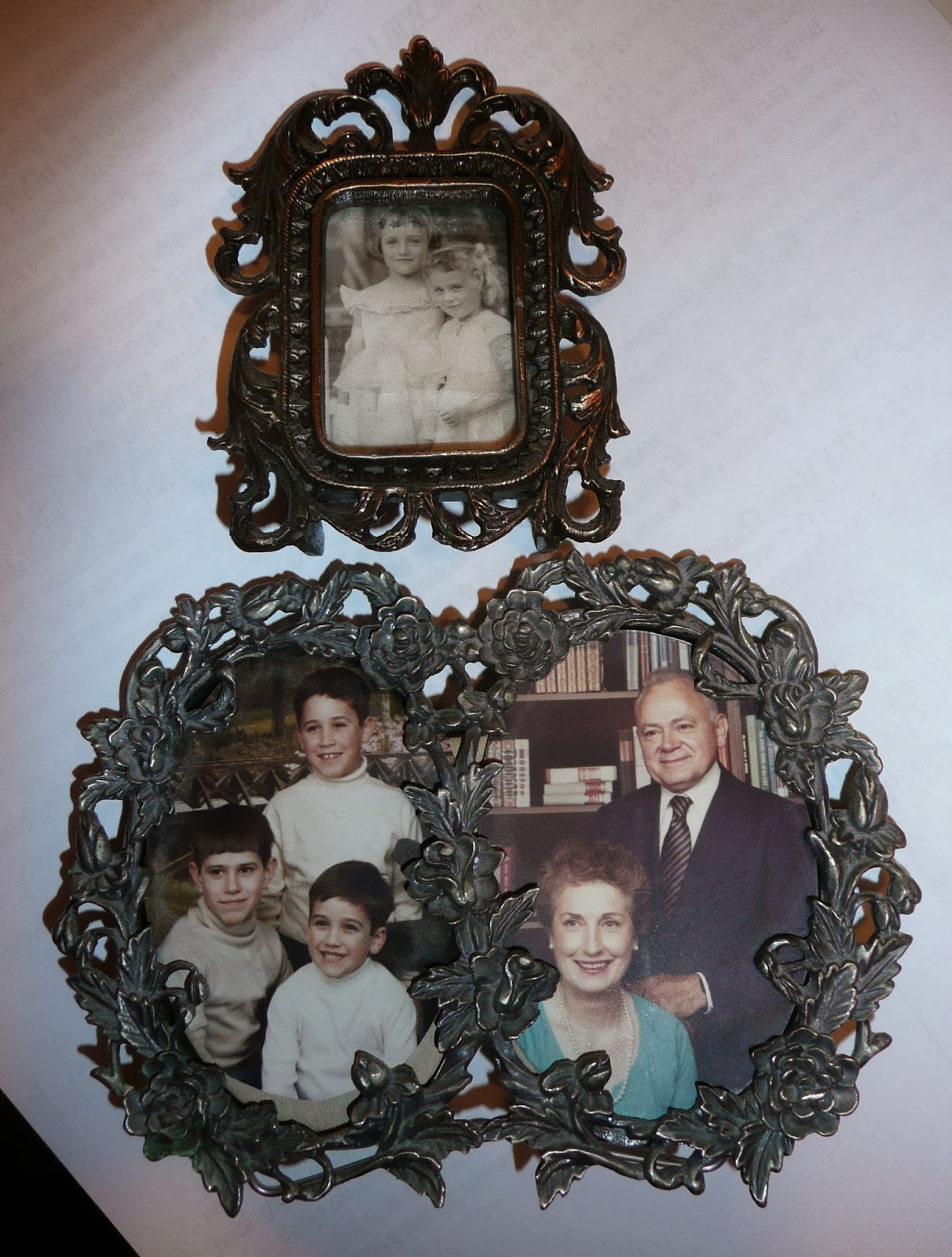
upper frame - my sister and I
ages 7 and five
lower frame my sons and
my parents 1984

In what followed my father's death the beautiful objects, so lovingly, artistically arranged and maintained were propelled from their set order or place; off into the unknown universe; a diaspora of all that was their life. What had been an enduringly cohesive whole atomized, exploded, fractured into shards.
 
Before it all went beyond reach I grabbed at some of the shards, little precious objects that were fixtures in their home and present to me my whole life. A few appear here. There are others: my Dad's slide rules in their leather cases so often seen on his drafting table, the little leather bound boxed chess set no bigger than a small paperback book which he carried with him to the Pacific in WWII and brought back in a duffle crammed with every letter he had received from my mother, a pocket knife, a watercolor painted by my mother. Each item of little value except to me and perhaps, this is my hope, to my children and grandchildren after me.
 

silver sewing kit box from Italy - 3x4 inches
 
However I find that when I look upon them I mourn the loss of the whole. Each object in their home was placed in artful relationship to others, a grand collection in reflection of their lives. These objects, in isolation from the whole, seem to have lost something. It does come to me that the loss represented in these objects seemingly removed from the ground of their being is only a reflection of my sense of loss, of my having been propelled into a new way of being, a new stage of life. No longer in this world is there anyone who came before me. who remembers before me, who can tell the old stories. I am now the elder and that has been a bit of a shock. I feel the burden of holding the stories and the need to keep sharing them, especially with the little ones so that when they receive the gift of these precious objects they will know something of their meaning to those who loved them so dearly.

Helmut Eric Nimke with family
March, 2013
 

Monday, November 12, 2012

Reflection for the Grieving

Remembering


The elders here will remember a phrase common in Catholic culture of the past; a phrase uttered by a grandmother, a parent, a sister who taught us in school. In response to one complaint or another we would be told, “Offer it up.” Being told to offer our suffering up to God always limped a bit because, as was also part of the culture of the time, we were not given any opportunity to voice the interior experience of disappointment, insult, neglect, pain, sorrow or grief. Today we have been educated to value the need to express feelings. We know that giving them voice is necessary for healing.

But after healthy sharing with compassionate friends, after joining a support group, after praying through the grief, and perhaps after seeing a counselor, a question remains in the heart, “What do I do with the pain?” In this we may need to re-appropriate the concept of “offering it up.”
We are created in the image and likeness of God. The spark of divine life has lived in us since the moment of our conception and that spark was fanned into flame when Jesus entered into the human sphere. We have a Savior who is like us in every way except sin. The gift of the Incarnation, the gift of Jesus taking on the total human experience was to draw us further into divine life. The ancient Fathers of the Church declared “God became human in order than we might become God.” What does that mean? It means that we fully participate in divine life here and now. We participate in the both the glory of God and the pathos of God’s suffering. So we can sit with our pain and say with St. Paul:
Now I rejoice in my sufferings for your sake, and in my flesh I am filling up what is lacking in the afflictions of Christ on behalf of his body, which is the church…Col 1:24
We need only to read the newspapers, watch T.V. news, survey our own families and friends to see the suffering held within the Body of Christ. Since the Incarnation unites in that Body we are one in the suffering of all humanity. But we do not sink into the suffering. Rather we unite our pain, our sorrow to the entire human experience. By our union with Jesus on the Cross we fully participate in the on-going Redemption of all creation. Even the quantum physicists are telling us that at a mysterious sub-molecular level everything is interconnected. Nothing happens without affecting everything else.
As you contemplate your loss, as you touch your emptiness, as you empathize with the pain of those made homeless by the storm, those being slaughtered in Syria, those who are starving in Africa, those who are homeless in our towns and cities, “Offer it up.” Unite yourself with the God who knows our suffering, who sees our tears and cries with us. Ask that your experience be incorporated into the on-going work of Redemption in our families, in our communities and in our world.
The reflection above was offered at an All Souls Memrorial service at St. Jospeh's Church in Kingston, New York.


Saturday, November 20, 2010

November: Month of the Holy Souls

Adele Chambart Tutter
October 26, 1932
November 20, 2007
Remembering Those Who Have Stepped
Through the Door:  The Story

Contemplative nuns in their monastic horarium are wedded to the events of the Liturgical Year and the special traditonal themes of prayer that are woven through it. November begins with the Feasts of All Saints and All Souls with special remembrance of them continuing until the end of the Liturgical Year. Before we launch into the wonderful first season of the Church's year, I would like to share remarks presented at the Annual All Souls' Remembrance Service in a local parish. Our grieving for the recently deceased and our continued mourning of their departure from our lives here can be complicated by "our story" and the weight of our loss. But light can still be found.

Each of us has come here today with a story. It is the story of our relationship with someone who has gone to the other side; who has passed through the door from one state of being to another; who is dwelling in the eternal presence of our loving God. But we have been left behind. And all we have is our story.

Three years ago I was called to the bedside of a dying friend – really more friend, mother, sister and spiritual companion rolled into one huge heart of love. She rallied a bit and the next day, as I sat silently waiting, her eyes opened and looking directly at me she said, “I have been told that I am going to be an angel.” She died within a week. When I think of her I know exactly where she is and with whom. And so I must rejoice. But every day I miss her. That daily missing may be part of your story too. When it gets very hard, I make myself think of all she wanted for me, of all she was sure that I could be and do. I think of how much she loved. And I move on. I move on in that positive direction to which she always pointed. I move on because it is the finest tribute to her memory that I can offer.

But, what if the story is not so sweet? What if, although love is surely there, disappointment, hurt, or betrayal is also present in the story? What if unresolved issues linger and unfinished chapters remain? It is a joy to remember the light and happy parts but we find the dark episodes very difficult. Yet, there may be a silver lining. The difficulties, however dark, may have developed in you a strength, a determination, a courage or gift of character or personality that has served you well in dealing with the rest of life. If you can recognize that you are more compassionate, more independent, more thoughtful, or more forgiving today because of the difficulties in your story, you can find a way to come to terms with painful memories.

Another strand woven through so many of our stories is regret. Sometimes relationships never develop into all that is possible. And we accuse ourselves. “I could have done…” “I should have done…” “Why didn’t I?” It may just be the ego or our savior complex talking. Or, perhaps, there may be some real truth emerging from examination of conscience. In either case, the story of your intertwined lives is over. The one we loved is in another place. What can we do with the regret? Completely filled with divine forgiveness, the one whom we mourn would have us make restitution in the here and now; to be, in the here and now, in live action at every moment possible, the very embodiment of the love we may have failed to offer in the past. It is never too late for that.

Love cureth all things. Love enables us to continue to strive for all that our beloved dead wanted for us in life. Jesus, mirror of the Father who is pure love, spoke of loving our neighbor as we love ourselves. Healthy self-knowledge and self-love can make us aware of some good that came out of even the greatest pain or hardship. With a dose of self-forgiveness and a willingness to make amends in the here and now, we can grow into and exercise that radical love to which Jesus invites us. We can overcome any regret or remorse lingering in our hearts.

These are ways to deal with our tremendous grief and embrace the varied textures of our stories which are always a mixture of light and darkness. Each is a great challenge. But Jesus soothes and comforts the troubled soul, saying over and over, “Do not be afraid…I am with you…I am the way.”