Showing posts with label reflections. Show all posts

Monday, January 07, 2019


Living Epiphanies

Reflection presented at Epiphany Concert of St. Joseph Church 
Music Ministry, Kingston, NY, January 6, 2019

As we close this season celebrating the mystery of the Incarnation – God becoming flesh; coming to live among us;  God coming to experience all of human life; Jesus coming to reveal the face of the Father ----- what nugget of inspiration can we underscore in our memory and carry into ordinary time?

Today we mark Epiphany but not merely the single incident of a few wise men or philosophers or seekers we call Magi  who complete their pilgrimage by finding the child Jesus and knowing in their hearts that he was the Messiah; the Messiah foretold by the prophet Isaiah who wrote: “The people who walked in darkness have seen a great light – for a child is born to us – They shall call Him Wonder Counselor, Father Forever, Prince of Peace.”

Epiphany means manifestation – an experience or event that makes something absolutely clear to the mind or to eye. In our Church tradition the Magi event is only the first of a number of events revealing the identity of Jesus. Soon we will celebrate the presentation of the child Jesus in the temple when it becomes manifest – absolutely clear – to Simeon and Anna that in this child was their salvation. Another is his baptism by John in the Jordan when the voice of God is heard saying, “This is my beloved Son.” Also the wedding feast at Cana when Jesus, by performing his first public miracle, makes perfectly clear his nature and his mission.

The nugget of inspiration we can carry away today is that the time of such Epiphanies need not be over. In fact, we need them more and more every day – moments in which the love of our God is made manifest in our world; when eyes plainly see and minds clearly apprehend the nature and work of God. 

It has been said that Jesus came into the midst of human kind to reveal the Face of a loving Father. Jesus is no longer physically present in this world reveal God’s love. But by virtue of our baptism, participating in his life as priest, prophet and king, we can and must reflect, in His Name, the face of God. In this way WE – how we act and react; what we choose to do and not to do; how we talk to people and not talk to them can be today’s epiphanies. Today and every day, we can make manifest the Loving Heart of God in the world. How do we do it? Didn’t Jesus give us lessons when he said:

       I came to serve, not to be served.
       Let those without sin cast the first stone.
       I give you a new commandment, love one another.

We cannot say that we do not know how to make manifest in this world the nature of a loving God. As Christians we can act out of the conviction that we are to become living memories, living epiphanies, affirming the presence Jesus in the world.

In the Letter to the Colossians it is made clear (3:12-21)
      And let the peace of Christ control your hearts, 
      the peace into which you were also called in 
      one body. And be thankful.

      Let the word of Christ dwell in you richly, as in
      all wisdom you teach and admonish one 
      another, singing psalms, hymns, and spiritual songs 
      with gratitude in your hearts to God.And whatever 
      you do, in word or in deed, do everything in 
      the name of the Lord Jesus, giving thanks to 
      God the Father through him.

Today we can go forward with this nugget from St. Francis in mind: “Preach the Gospel at all times and when necessary use words”. Carry that golden nugget in your pocket as a reminder because “what the world needs now is love, sweet love.”


Sunday, January 07, 2018

Epiphany Reflection 2018

"By Another Way"

Brother Max Schmalzl, CSsR
1850-1930
Reflection offered at Epiphany Concert of St. Joseph's Church, Kingston, NY - January 7, 2018

Today we mark the end of the Christmas season by remembering the Three Kings, Wise men from afar. Guided by the light of a star and following the suggestion of a brutal scheming King, they arrived at Bethlehem of Judea and offered homage to the one they immediately recognized as a Holy Child of God. “And having been warned in a dream not to return to King Herod, they departed to their country by another way.” While knowing the story by heart I was struck this time around by the repeated mention of light in what are called the Infancy Narratives of the Gospels. I was also struck by the very last words of the account; they ‘returned home by another way’. The act of going another way took on new meaning.

Ephipany is one of those fancy church words that comes from the language of ancient Greece. Today we commonly use the word to describe a Eureka moment when suddenly it is as if a light bulb goes on in the brain and we can finally say, “I got it.” Suddenly you fully ‘get’ a new concept or know how to use that new app on your I-phone just plain get a great idea. This common use is not off the mark. In Greek the word indicates a manifestation - a great reveal – an occasion when it seems a great light has been focused on a new truth.

Today we are thinking about those three wisdom figures who traveled from afar and following a star, came to a stable where God revealed the divine nature of an otherwise totally unremarkable child. But this event is only the first in a trio of Eureka moments in which the Messiah was revealed.  The next is the baptism of Jesus when Luke tells us the voice of God was heard saying “You are my beloved Son; with you I am well pleased.” The third is the wedding feast in the town of Cana told in the Gospel of John where Jesus turned water into wine to save a family from embarrassment. Scripture says, “Jesus did the first of his signs in Cana of Galilee and revealed his glory and his disciples believed in him.”

Christians have tied together these three revelations of Jesus’ identity from the earliest days. Our Episcopalian sisters and brothers call the whole length of time from today to Ash Wednesday Epiphany-tide. That designation prolongs the period in which we are invited to meditate on our personal response to the Christmas revelation of Jesus as the Son of God, the Messiah of our ancient longing.

It is interesting that we use the image of a light bulb coming to life to describe our Eureka moments. Light imagery so often appears in Scripture to explain what the revelation of the Messiah will mean for us. The three Kings were led by the light of a star. The last lines of the great prayer of the father of John the Baptist tell us that when the Messiah reveals himself, “The dawn from on high will break upon us to shine on those who dwell in darkness and the shadow of death and to guide our feet in the way of peace.” Much earlier in Hebrew scripture the prophet Isaiah declared:

The people who walked in darkness
have seen a great light;
Upon those who lived in a land of gloom
a light has shone…
For the yoke that burdened them,
the pole on their shoulder,
The rod of their taskmaster,
you have smashed, as on the day of Midian.
For a child is born to us, a son is given to us;
upon his shoulder dominion rests.
They name him Wonder-Counselor, God-Hero,
Father-Forever, Prince of Peace.                                  Isaiah 9:1,3,5

Even today we harken back to the light metaphor in our Christmas candles, our brilliantly lit homes, and sparkling decorations on evergreen trees. The real significance of these lights is that they draw attention to and underscore the central spot light focused on the child lying in the food trough of barnyard animals behind an inn with a no vacancy sign.
If that is the Epiphany moment; if seeing the new born child reveals his identity as our Messiah what, if anything is that supposed to do to us? I propose that these Epiphany revelations of Jesus as Lord and Savior have to become conversion moments; bringing us to a new path in our daily pilgrimage journey to God, giving us the choice to go home by another way.

We are told by Isaiah the Prophet that the Messiah will bring this message:

The spirit of the Lord GOD is upon me,
because the LORD has anointed me;
He has sent me to bring good news to the afflicted,
to bind up the brokenhearted,
To proclaim liberty to the captives,
release to the prisoners;
To announce a year of favor
and a day of vindication by our God;
To comfort all who mourn;
To give them oil of gladness instead of mourning,
a glorious mantle instead of a faint spirit.               Isaiah 61

Like the Kings we came to the manager at Christmas. We are told that after their Epiphany moment the visitors offered their gifts to the babe before them and then “return home by another way.” I know they are trying to avoid the evil Herod. But “going home by another way” suggested to me that they went home changed by the light, changed by their Eureka moment.

Our Epiphany moment must bring us to conversion, a commitment that invites us to follow another way; the way of bringing good news, binding broken hearts, releasing those imprisoned by any circumstance, comforting those in sorrow, and spreading the oil of gladness far and near. The other way may lead us into our various communities or most especially to those with whom we share the dinner table at home. This other way is marked by an increase of compassion, kindness, humility, gentleness and patience; all under the mantle of love which we are told is the bond of perfection.


Robert Frost poetically described the moment of choice and consequences unimagined.

The Road Not Taken by Robert Frost

Two roads diverged in a yellow wood,
And sorry I could not travel both
And be one traveler, long I stood
And looked down one as far as I could
To where it bent in the undergrowth;

Then took the other, as just as fair,
And having perhaps the better claim,
Because it was grassy and wanted wear;
Though as for that the passing there
Had worn them really about the same,

And both that morning equally lay
In leaves no step had trodden black.
Oh, I kept the first for another day!
Yet knowing how way leads on to way,
I doubted if I should ever come back.

I shall be telling this with a sigh
Somewhere ages and ages hence:
Two roads diverged in a wood, and I—
I took the one less traveled by,
And that has made all the difference.

Sunday, September 11, 2016

Coincidental Feast?
Blessed Maria Celeste on 9/11


Today marks the first celebration of the feast day of Blessed Maria Celeste Crostarosa, foundress of the Order of the Most Holy Redeemer, the Redemptoristine contemplative nuns. This otherwise obscure 18th century native of Naples, Italy is being honored today all over the world in the monasteries of the order she began in 1731.

Death mask of Blessed Maria Celeste Crostarosa
1696 - 1755
It was not until my pastor began his homily at Mass this morning that I thought about the coincidence of Maria Celeste's feast and the memorial of the tragedy of 9/11, the terrorist attack on the World Trade Center in New York City in 2001. For Americans, at least, this significant day will always merge remembering her with remembrance of  an horrific event, lost lives, and sorrowing survivors. Our fine priest focused on the question, "Where was God in all of this?" He emphasized God's presence in the generosity, bravery, service, community, cooperation and all good things and people we witnessed on that day and the days that followed to this time. He said that these were the presence of God and pointed to love as the response God invites us to have in the face of such horror - a turning away from vengeance, violence, prejudice and rejection of human beings.

Those who know Blessed Celeste's story will know that she endured more than her share of being misunderstood and rejected; of exile and pilgrimage to find her place. She also wrote a great deal leaving us an inspiring heritage of her spirituality. The image of her used here is my favorite because it is so real. Some in the order speak of her as Mother Celeste. I think of her as Madre Celeste or, even better, Mama Celeste, a wise and mature Italian woman who has been through her share of sorrow. She is a wisdom figure constantly pointing to her salvation; an extremely intimate relationship with Jesus, our Savior. In her writings I did not find a directive for severe personal penances or rigidity in community life. Her constant directive is for LOVE; love for Jesus and love for one another. What better antidote for the horror of the 9/11 tragedy? This is what my pastor was emphasizing. Was the Holy Spirit at work in the coincidence of these memorials?

Blessed Maria Celeste painted a picture of a precious hidden garden which she said was the image of the human soul. God wants to enter that garden and spend intimate time with the soul who generously opens the gate of the heart. Sharing her own experience of the interior garden she reported what Jesus told her, "If they ask you who I am, tell them I am PURE LOVE." It is this PURE LOVE which is our finest offering on this day of remembrance.


Friday, January 01, 2016

Solemnity of the Mother of God


And Mary kept all these things, reflecting on them in her heart.
Luke 2:19

Reflecting in Her Heart

The first day of this New Year finds me in a new way of life; a way of life totally unanticipated at the beginning of 2015. I am no longer a Redemptoristine nun. I no longer live in a monastery pursuing the daily round of prayer, work and recreation. I can no longer depend on the work of others to keep life spinning. It is hard, at times, to know who I am now. (A previous post offers some background to this profound change.)

To append this change to the list of events to which I often refer as "my checkered past" makes me shake my head in disbelief. Italian-American Brooklyn boomer, daughter and sister, college girl, wife, mother, divorcee, single mom to three sons, teacher, graduate student, librarian, parish and community volunteer, contemplative nun, grandmother, and at the age of 70 a lay person once again. It really makes me wonder.

Running over the list in my mind I most often tend to dwell on how much I messed up; all the times and places in which I failed; all the people I let down and did not love well; and all the times I imagine being a disappointment to God. I see all the broken places.

But I have been urged to turn away from notions of brokenness and rather to ponder the continuity of spirit (with an upper case 's' as well as lower) which undergirds the meandering events and occupations of my life. 

The presence of God was always there; the guidance of the Spirit; desire for the Holy One; and the "Hound of Heaven" unrelenting in pursuit of a soul often not knowing where it was headed.

Today's Gospel is a simple one concerning the shepherds coming to see Jesus and praise Him and Mary's reaction to it all. Luke says, "Mary kept all of these things, reflecting on them in her heart." Another translation offered, "Mary wondered at these things, and pondered them in her heart." I wonder and I ponder. "Wonder" suggests awe at the mysterious ways of God and "ponder" speaks of the effort to plumb all these things for depth of meaning.

I have said that I am currently exploring a new contemplative path, a way of living contemplatively in the world as a lay person. In this context my small but very comfortable apartment may be considered my hermitage. I do relish my time here alone. But I am too much of an extrovert to ever dignify myself with the title of hermit. Rather I have returned to an image from the writings of Maria Celeste Crostarosa, foundress of the Redemptoristine Nuns. One collection of her writings is entitled "Il Giardinetto", or "The Little Garden."

But this is no ordinary garden. She suggests that a more precise meaning is this; that for God the 'giardinetto' is the dear enclosed garden in which God and the soul enjoy each other. My little place can be this enclosed garden. It has all the verdant, cool, shady loveliness and protection of a childhood remembrance; the lush grape arbor seriously cultivated by the old Italian immigrant gentleman who lived next door.  

So as Mary kept, wondered, reflected and pondered in her heart the wondrous things that had taken place in her short life, I do the same but with a longer list unrolled over a whole life time and still unfurling to reveal its mysteries. In daily meditation I struggle to center myself, to enter the precious enclosed garden and ponder the meaning.


Saturday, August 01, 2015

Reflection for Feast of St. Alphonsus


Medicine for All


The scripture readings for this solemnity honoring St. Alphonsus de Liguori are so fitting. From Isaiah; “… He has sent me to bring good news to the oppressed, to bind up the brokenhearted, to proclaim liberty to captives, and release to prisoners; to proclaim the year of the Lord’s favor…” And from The Gospel of Matthew; “…He saw the crowds; he had compassion for them, because they were harassed and helpless, like sheep without a shepherd.” These embody Alphonsus’ inspiration received during time of retreat in the rural hillside settlements beyond Naples. While one could fairly trip over priests on the streets of Naples no one came to the remote villages to minister to simple souls. This inspiration was to become the guide for Redemptorists, an anthem of service to the poor and most abandoned.
It is beyond me to understand how this inspiration morphed into a Redemptorist reputation some of us still remember,  those parish missions preaching hellfire and brimstone. However that may have come to be, today we can offer praise and thanksgiving to God for the fruits of post-Vatican II renewal in the Redemptorist Congregation and its return to preaching the true message of Alphonsus.
           Alphonsian spirituality had three legs, the crib, the cross and the Eucharist, each one supporting its preeminent platform – God’s supreme love. Each leg is the expression of that love; the crib of the Incarnation, the cross of the ultimate sacrifice and the Eucharist as the love gift that keeps on giving. Alphonsus spoke of God not as Lord or King or Father but rather as friend, brother, mother, spouse, and lover. His God, the God he begs you and I to love and trust as our intimate companion, is a God insanely in love with us. This is the God he called “Iddio Pazzo” the crazy God, the crazy God of love, who is insanely in love with us. He wrote, “Heaven for God is the human heart.”

But here is another thing that is hard to understand. This preacher of God’s love, this theologian who bucked the popular tide of rigorism and Jansenism, who opposed sterile legalism because, according to him such rigor was never the true teaching of the Church; this was a man who was plagued all his very long life of 91 years by a sometimes crippling scrupulosity. He ran through spiritual directors. The successful ones had to forbid him to even think of not celebrating Mass because he questioned his worthiness to do so. In the matter of his inspiration to create a new congregation to serve the most abandoned he went from one person to another with his self-doubt and uncertainty. Maria Celeste’s enthusiasm and sense of right direction for her own foundation and strong encouragement for his seems to have moved him at long last into decisive mode. 
All his life Alphonsus bore the weight of high expectations from both his father’s military bearing and his mother’s thorough piety. He never ceased to be hard on himself. He even made private vows never to waste time and to persevere in his vocation. The antidote for his scrupulosity was meditation on the lover God, Iddio Pazzo, who expressed infinite love in the mystery of the Incarnation, the sacrifice of the Cross and gift of the Eucharist.  Alphonsus allowed himself to bathe in the warm waters of that meditation. And it would seem that part of his treatment was to turn his whole life into an effort to communicate that love to the world. The antidote for his addiction became a gift to be poured out for others; not merely in the form of good deeds but in the effort to guide people into their own acceptance of and growing relationship with the God who is pure love.
I ask myself, “Can I, like Alphonsus, turn what the God of love speaks to me in my own struggles, into gift for others? Can we apply God’s medicine received in our struggles to the healing of others even as we continue to endure personal challenges?
 I can never be perfect.  Alphonsus was never perfect. He was a holy genius who must have been a trial to live with. But he wrote instructions to others to see to it that brothers had their treats and he walked the Stations of the Cross bare foot in the hallway so as not to disturb his sleeping confreres. He worried about them during their missions and welcomed them home. He warned them not to be highflootin’ in their preaching and railed against those who would deprive people of Holy Communion. He took money from diocesan coffers to buy food for the poor during a time of famine. He must have been so proud of his son in the congregation, Fr. Bernard Haring who said, “The heart of moral life is charity to one’s neighbor.”
            Alphonsus de Liguori shared the medicine he found for his soul with all who would listen to his mission preaching, those who would read his 110 books. He shared the medicine which was the infinite love and mercy of God. This Doctor of the Church, dispensed medicine in the hospital which is that Church, the healing, forgiving, merciful hospital spoken of by Pope Francis. In this regard, Alphonsus is a theologian for our times, inspiration and guide for the Year of Mercy.
            Can we pray with Alphonsus:
My God and my all, I will resist you no longer. I will leave all to be all yours. I will no longer live for myself… Your claims on my love are too great. My only desire is to love you now and forever. My love, my hope, my courage, my comfort; give me strength to be faithful to you. .. O love of my soul, I offer myself completely to you to satisfy the desire which you have to be united with me… Give me strength to think of you, to desire you, to seek you, my beloved and only good.
 

Friday, April 03, 2015

Good Friday Reflection

Visualizing Nicodemus


Today I served as narrator for the Passion of Christ according to the Gospel of John read during our Good Friday Liturgy.  I have been privileged to present this dramatic story many times and have heard it read every Good Friday for over 60 years. In this case I volunteered for the task because I know that in trying to read in a clear and meaningful way, allowing my voice to reflect when able the tension, emotion or import of a scene, leads me deeper into the story and can become an occasion of grace.

We are blessed to have a very scholarly local pastor who is gifting us with his reflections on the presentation of human encounters with Jesus in the Gospel of John. The first focused on Nicodemus who came in the safety of night to see Jesus and ask questions. Our discussion centered on the inherited faith of this Pharisee, his motivations and his fear. We hear little afterward about Nicodemus and any possible changes of heart until the Passion narrative. Here it seems that Joseph of Arimathea and Nicodemus, likely onlookers at the crucifixion, conferenced over their need to do something and assigned each other specific tasks. Joseph would approach Pilate and ask for the body of Jesus and Nicodemus would obtain the traditional spices to be inserted into the burial cloth wrapped around it. Although he visited under cover of night when Jesus was alive he could hardly carry one hundred pounds of spices through the streets and remain an invisible Jesus sympathizer.
 
Today, as I read the few words concerning Nicodemus' compassionate bravery an image of him flashed through my mind; the image created by Michelangelo in an unfinished Pieta begun in the last years of his life. I saw it in Florence 55 years ago. Here is what Wikipedia has to say about it:
 
The Deposition (also called the Florence Pietà, the Bandini Pietà or The Lamentation over the Dead Christ) is a marble sculpture by the Italian High Renaissance master Michelangelo. The sculpture, on which Michelangelo worked between 1547 and 1553, depicts four figures – the dead body of Jesus Christ, newly taken down from the Cross, Nicodemus (or possibly Joseph of Arimathea), Mary Magdalene and the Virgin Mary. The sculpture is housed in the Museo dell'Opera del Duomo in Florence. [The Duomo is the Cathedral of Florence.]
 
According to Vasari [biographer of Italian Renaissance artists], Michelangelo made the Florence Pietà to decorate his tomb in Santa Maria Maggiore in Rome. Vasari noted that Michelangelo began to work on the sculpture around the age of 72. Without commission, Michelangelo worked tirelessly into the night with just a single candle to illuminate his work. Vasari wrote that he began to work on this piece to amuse his mind and to keep his body healthy.
 
After 8 years of working on the piece, Michelangelo would go on and attempt to destroy the work in a fit of frustration. This marked the end of Michelangelo’s work on the piece and from there the piece found itself in the hands of Francesco Bandini who hired an apprentice sculptor by the name of Tiberius Calcagni to restore the work to its current composition. Since its inception, the piece has been plagued by ambiguities and never ending interpretations, with no straightforward answers available.
 
The face of Nicodemus under the hood is considered to be a self-portrait of Michelangelo himself.
 
It is interesting to think about Michelangelo in his last years contemplating his life, anticipating his death, and choosing to immortalize himself in the face of this character. I can imagine him facing in memory his flawed character and his failures in faith but also his last clinging to the suffering Jesus; Jesus who in his humanity also died. In this Pieta Michelangelo is the frightened onlooker brought to faith and completely humbled by what he has witnessed.
 
In the split second of accessing the image of Nicodemus as I read into a microphone there came the grace to know that I am Nicodemus in this story. We are all Nicodemus; all onlookers standing on the stony soil of Golgotha, having a hard time absorbing the shock of being witnesses. We are all Nicodemus in our regrets, in remembering our flaws of character, our failures in standing up for truth and justice, our fear of what others might say about us. We are pitiful. But we cannot just go away under the weight of our self-recriminations. We especially cannot do that today because we know the end of the story.
 
Instead we can, like Nicodemus, accepting who and what we are and the mistakes that have been made, choose to move in a new direction, chose to make ourselves useful. We can choose to remember and act upon the words of Jesus that we heard just yesterday in the Liturgy of the Lord's Supper. "Do you realize what I have done for you?.....I have given you a model to follow, so that as I have done for you, you should also do."
 

Friday, March 20, 2015


This tribute was first published here in 2012.  

Death of an Urban Saint
 
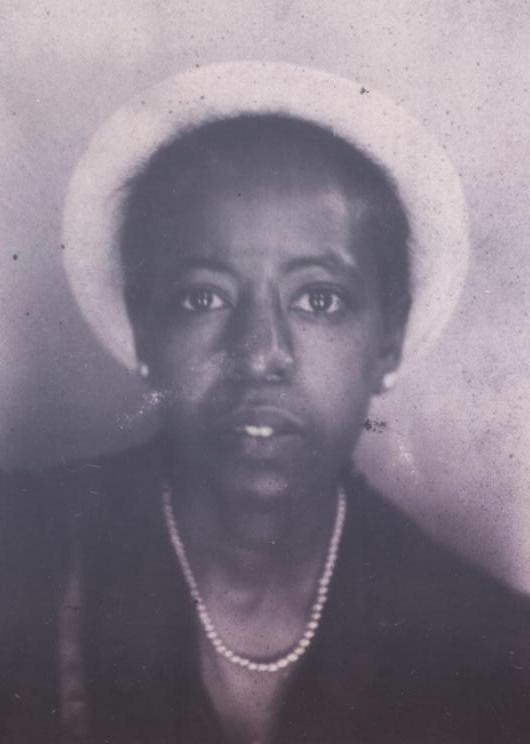
       Athalie “Betty” Elizabeth Wimbish, was familiar to residents of uptown Kingston, New York as a local presence from the early1940s to the early 80s; a women of color dressed entirely in black daily making her way from her home on Prospect Street or from St. Joseph’s Church on to London’s Clothing Store at the intersection of Wall and North Front Street where she was employed for thirty-three years. To those who did not know her history she was just “Black Betty”. Betty died at Ferncliff Nursing Home on Good Friday, April 6, 20012 at the age of 95.
She was born on August 4, 1916 at 100 Gage Street, Kingston,
Kingston High School 1934
the daughter of Andrew and Blanche Elizabeth Wimbish and grand-daughter of Hannah “Hattie” Jackson Betty spoke proudly of the African slave heritage of her father combined with the African, Spanish and Dutch ancestry of her grandmother. She recalled that in her childhood a Dutch dialect could still be heard in Kingston. Athalie Wimbish graduated from Kingston High School in 1934. There she wrote interviews for “Dame Rumor” and played basketball. The year book indicated that she was college bound and spoke of missionary work in Africa.


Her childhood was spent in Albany Avenue mansions where her grandmother and mother served as housekeepers and her father as driver and handler of carriage horses. One employer was owner of the Fuller Shirt Factory. In these settings and as a precocious child of mixed race she was exposed to a variety of educational influences. Her grandmother provided religious formation at both St. John’s Episcopal Church on Albany Avenue and the AME Zion Church on Franklin Street.
Following graduation from high school Betty Wimbish ventured to the Big Apple where although disappointed in her effort pursue a nursing education she experienced the excitement of the Harlem Renaissance and later her first trip to Europe. Early in the 1940s she returned to Kingston to care for her mother and grandmother, working first at Montgomery Wards where she replaced her mother as elevator operator. Beginning in 1943, she fulfilled many tasks for London’s, including inventory, accounts receivable, shipping aid packages to Stanley London’s relatives in Europe and providing secretarial assistance to Mrs. London who was President of Hadassah, a Jewish organization for women. During this time, London’s was the only white owned business that would hire Black teenagers.  Betty spoke of them as “my boys” and took these youngsters under her wing as a woman of color guiding them in the requirements of a responsible working life. Some remained in contact with her for years. The London family was always concerned for Betty’s welfare and that of her family. After her retirement they provided a security system for her home and continued to send  ‘pension’ funds.
First attracted to the Catholic faith during her time in New York City, she was received into the Church in the 1940s at St. Mary’s Church in Kingston which was very welcoming to people of color. After being rejected in an effort to become a Catholic sister because of her race, she made a decision to serve the Church in every other way possible; as catechist at St. Mary’s; as prayer support to any number of priests including Rev. Daniel Egan known as the “Junkie Priest” who was one of the first to draw attention to the need for drug addiction treatment; as participant in the ecumenical efforts of the Franciscan Friars of the Atonement at Graymoor, Garrison, NY, and as a tireless fund-raiser for overseas missions.  She was a member of a world-wide mission tour in 1965 which included stops in Hawaii, Japan, India and the Holy Land. In India she sat on the dais during Mass celebrated by Pope Paul VI.
Around the time of her conversion to Catholicism Ms. Wimbish made a life choice, a preference for personal poverty and simplicity motivated by her deep faith and supported by a lifetime of contemplative prayer. By the 1970s she had assumed this persona to such a degree that she became known only as “Black Betty”, dressed always in black from head to toe with a kerchief or beret covering her head at all times. She was readily recognized on uptown streets as she walked to and from daily Mass and on to work. For more recent residents of the city she merely seemed to be a local character, the woman in black who swept the floors at London’s clothing store.
After retirement in 1976, she became an urban hermit, praying constantly, serving as confidant and aide to the poor and as a conduit of funds she received from more fortunate friends. Agnes Scott Smith, now deceased, who taught at Kingston High School, described her as “quietly pious, an enigma who became a nun without going into the convent.” By 1985 Betty’s daily hikes from Prospect Street to St. Joseph’s became too arduous so a few parishioners began to visit her weekly to bring her spiritual food in Holy Communion and also fresh fruits and vegetables for bodily nourishment. A number also kept her supplied with donations which she, a keen judge of character and need, would pass on to others of all shades of color who came to the door seeking guidance or material assistance.  The women who prayed with her came to know her sanctity first hand. Some even came to know her secrets and her wisdom.
With time her memory of the present failed. Yet, memories of the past never faded. She claimed to know the skeletons in many Kingston closets at all locations on the color spectrum. She spoke of attending as a child a ceremony at the Kingston Academy and of arriving late at Kingston High School and being rushed to class by Kate Walton for whom the field house is named. She spoke of being appalled at Jim Crow Laws in the south when visiting her father’s family. For those who took the time to know her she was a knowledgeable and well-read world traveler. In the end, she became an urban saint, a hermit in the midst of the city, praying constantly.
And Betty would admit to having the humor of a rapscallion. Upon bidding her goodbye, a guest could teasingly say, “Now, be good.” To which she would reply, “Now don’t you threaten me!” But her last words were always, “God bless you.”

I visited Betty once a week for over ten years. We laughed, prayed, spoke of the local news, shared memories and stories, spoke of our troubles and consoled each other. Betty generously introduced me to the Black, African American, sensibility. Her personal history was a revelation and inspiration to faith, perseverance, love of family and personal sacrifice. She taught me such expressions as "The blacker the berry the sweeter the juice" and "What's bred in the bone cannot be beaten out of the flesh." To know her was a privilege, an unforgettable privilege. 
 

Sunday, November 02, 2014

All Souls' Day Reflection

 
A Gift of Presence
for the Digital Age
 
Reflection presented at
All Soul's Day Prayer Service Concert
St. Joseph's Church, Kingston, NY
11/2/14


We have so much in common today. We have all come to remember and celebrate those who have gone before us. Although we come in different stages of grief, with different flavors of remembering, our interior questions are probably quite similar. “How can I handle this? Where do I go from here?” The fortunate among us may have had a wise soul or a spiritual guide offering a willing ear. These treasures, like my spiritual director, share our sorrow and tears. They remind us that Jesus who wept at the death of his friend Lazarus is a companion in our sadness and grief. But then my spiritual director, as all good directors should do, asked the big questions. “And what is God saying to you in all of this? What opportunity is God asking you to find in your grief?”
          Bereavement is an experience of the loss of a presence in our lives; a presence that may have been influential, someone involved in our lives, available and responsive. However, it is also possible that we are grieving not only the loss of a person but also regretting the opportunities we missed to enhance our relationship with that person while still alive.
          Since we experience so keenly now the absence of a presence in our lives; since we may regret lost opportunities to be present, to be in meaningful relationship with the one who is gone; could it be that our loving God is inviting us to a new awareness of the quality of our own presence in the lives of others? Can this invitation be translated into a quality of presence that makes us better listeners, more generous with our time, more compassionate in response, and much less the masterful know it all problem-solver?
          Jesus was generous with his presence, so generous that he had time to see, really see people, even to seeing into their hearts. While in the midst of crowds he was attentive and he noticed. He noticed the tax collector Matthew bent over his coins. He noticed Zachaeus who had scrambled up a tree to get a better view. In both he saw a generosity of heart invisible to others. He felt the hand of the sick woman touch his cloak in the press of the crowd; stopped his forward momentum and took the time to praise her faith and provide the cure she sought. And when an unnamed woman approached him during a feast at Bethany he accepted her gestures of devotion even when others objected. He allowed her to anoint his body with fragrant perfume and with his words memorialized forever the depth of her love.
Speaking of feasts – the Gospels indicate that Jesus liked dinning with his friends. He liked to linger at table, hearing their questions and responding to them with homey yet instructive stories. His presence was gift.
          As Christians we are asked to imitate Jesus in all things. In our sense of loss is a seed, the seed for growth in Jesus’ quality of attentiveness to others. It is an invitation to grow into a more radical form of personal availability, of listening, of presence than has been our ordinary habit. This is a contemplative attitude toward relationship. It is a Jesus attitude. It also happens to be a very timely antidote to an explosion of communication without depth or feeling experienced this digital age. We find ourselves participating in a frenzy of communication. I am as guilty as anyone – busily at work as webmaster, Facebook page organizer, blog poster, e-mail user and most recently trying to master the I-Phone.  I would not give them up. These digital tools can be used to spread the Gospel Word, to work more efficiently, to just keep in touch. But texts, e-mail, tweets, blogs and Instagrams cannot provide an arm around the shoulder, a listening ear, a gift of quality time in family or with friends. Digital communication does not allow for reading the expression on a face, the tremor in the voice, or the body language that speaks in silence. This is the very quality of the one on one human presence, face to face, in the now that we miss in grief for our loved one and what we may wishing we had offered in the past.
          Consider the invitation that God may have wrapped up in your loss. Consider the invitation to a more loving quality of attention, awareness, and availability in all of your daily interactions. These may come at the kitchen table, in the line at the supermarket, at the next soccer game, or when all you hear is the sound of the TV and everyone’s head is bent over one device or another. It is a very timely appeal in our current technological age. This is the stuff of which our spiritual lives are made. Our response may be the finest tribute we offer in memory of our loved one, the quality of whose presence made such a difference in our life.

Tuesday, March 25, 2014

                  
 In Memoriam:

Esther Higgins

              Human Being Extraordinaire

There was absolutely nothing half-hearted about Esther Higgins. It seemed that she was constitutionally incapable of holding back in extension of her loving nature. We know that her beloved Martin, husband of over 50 years, might be able to give evidence to the contrary and perhaps her children too. There must have been moments of temper, frustration, and sadness. But her friends, neighbors, parish community, staff and most especially the students at Linden Avenue Middle School saw her only as the most generous, caring, hardworking, perpetually positive and frequently laughing person ever.
 
Large institutions - businesses, hospitals, and schools at every level - are often overwhelming and in spite of being service oriented entities can seem the very opposite for many individuals. Relief can come in the presence of a person, often not a professional, who by virtue of her humanity and personality, can provide the beating generous, sympathetic heart of the place. This is the person who can miraculously break the tension, restore confidence, heal crushed hearts, and remind one person at a time and face to face that they are good and valuable. This was Esther Higgins' role at Linden Avenue School. Thus Esther cannot simply be described as a school secretary or aide. Esther was a genius at educational facilitation. One could observe her defusing the temper and resentment of a student arriving at school within minutes of an upsetting incident at home. This spared some teacher the task of having to settle down a whole class if the fuse was still afire at first period bell. The guidance counselor had an informal assistant in Esther who in little but oh so meaningful ways could provide follow-up by a brief daily check in with a youngster who needed support and to know that somebody really cared. She was informal counsel, second mother, confidante, ego and self-confidence builder for students, and some adult staff members too. And the adults knew that she could be counted upon to facilitate a solution to any scheduling foul up, to find those missing supplies, to be there when needed. Principals could come and go but support staff such as Esther remained to provide continuity in their knowledge of how things really worked, what kids needed, and to be the smiling face and pleasant voice of the front office.
 
I met Esther in 1980. The fact that I had known Esther for a long time was always a surprise to Red Hook folk. Esther and I had a little secret between us. We both participated I in an At Home Retreat sponsored By Linwood Spiritual Center in Rhinebeck. We were 13 women meeting once a week for 13 weeks led by a religious sister and a married woman. We came as women of faith wanting to have that faith enriched. Esther and I both came with great pain weighing upon us. I was to learn of the recent death of her son Marty and she would learn of the creeping deterioration of my marriage. Women are relationship people and Esther was more so, even in the depth of her personal grief. She made a special trip to my Kingston home to gift my son with a copy of Shel Silverstine's book "The Giving Tree" to mark his First Communion. When Don Germaine introduced me to his office staff in 1990 Esther and I just looked at each other. The ties formed by our deeply shared experience years before shot between us with magnetic force. We knew lots about each other that was not public knowledge. We had a bond.
 
St. Francis of Assisi is said to have given this advice to his confreres. "Preach the Gospel. Use words if you must." In these terms Esther was the supreme teacher. She spoke of God as pure love. She acted as if it was her obligation to demonstrate that truth. While very devout, she did not preach with words. Her pulpit was any human situation in which she found herself. She exercised the priesthood of her baptism by befriending, helping, joking, listening, healing, laughing and, on many days, just plain working hard.
 
To write this is an inadequate redundancy. Those who never met Esther cannot really image this person and for those who did, my description is unnecessary. They were given the blessing of knowing Esther. My human heart has been sad these days and writing here has helped my grief. But my soul is rejoicing. Esther is in the embrace of God. She has the ear of God and will undoubtedly be offering what would be best for those she loved and left behind.