Showing posts with label art. Show all posts

Friday, April 03, 2015

Good Friday Reflection

Visualizing Nicodemus


Today I served as narrator for the Passion of Christ according to the Gospel of John read during our Good Friday Liturgy.  I have been privileged to present this dramatic story many times and have heard it read every Good Friday for over 60 years. In this case I volunteered for the task because I know that in trying to read in a clear and meaningful way, allowing my voice to reflect when able the tension, emotion or import of a scene, leads me deeper into the story and can become an occasion of grace.

We are blessed to have a very scholarly local pastor who is gifting us with his reflections on the presentation of human encounters with Jesus in the Gospel of John. The first focused on Nicodemus who came in the safety of night to see Jesus and ask questions. Our discussion centered on the inherited faith of this Pharisee, his motivations and his fear. We hear little afterward about Nicodemus and any possible changes of heart until the Passion narrative. Here it seems that Joseph of Arimathea and Nicodemus, likely onlookers at the crucifixion, conferenced over their need to do something and assigned each other specific tasks. Joseph would approach Pilate and ask for the body of Jesus and Nicodemus would obtain the traditional spices to be inserted into the burial cloth wrapped around it. Although he visited under cover of night when Jesus was alive he could hardly carry one hundred pounds of spices through the streets and remain an invisible Jesus sympathizer.
 
Today, as I read the few words concerning Nicodemus' compassionate bravery an image of him flashed through my mind; the image created by Michelangelo in an unfinished Pieta begun in the last years of his life. I saw it in Florence 55 years ago. Here is what Wikipedia has to say about it:
 
The Deposition (also called the Florence Pietà, the Bandini Pietà or The Lamentation over the Dead Christ) is a marble sculpture by the Italian High Renaissance master Michelangelo. The sculpture, on which Michelangelo worked between 1547 and 1553, depicts four figures – the dead body of Jesus Christ, newly taken down from the Cross, Nicodemus (or possibly Joseph of Arimathea), Mary Magdalene and the Virgin Mary. The sculpture is housed in the Museo dell'Opera del Duomo in Florence. [The Duomo is the Cathedral of Florence.]
 
According to Vasari [biographer of Italian Renaissance artists], Michelangelo made the Florence Pietà to decorate his tomb in Santa Maria Maggiore in Rome. Vasari noted that Michelangelo began to work on the sculpture around the age of 72. Without commission, Michelangelo worked tirelessly into the night with just a single candle to illuminate his work. Vasari wrote that he began to work on this piece to amuse his mind and to keep his body healthy.
 
After 8 years of working on the piece, Michelangelo would go on and attempt to destroy the work in a fit of frustration. This marked the end of Michelangelo’s work on the piece and from there the piece found itself in the hands of Francesco Bandini who hired an apprentice sculptor by the name of Tiberius Calcagni to restore the work to its current composition. Since its inception, the piece has been plagued by ambiguities and never ending interpretations, with no straightforward answers available.
 
The face of Nicodemus under the hood is considered to be a self-portrait of Michelangelo himself.
 
It is interesting to think about Michelangelo in his last years contemplating his life, anticipating his death, and choosing to immortalize himself in the face of this character. I can imagine him facing in memory his flawed character and his failures in faith but also his last clinging to the suffering Jesus; Jesus who in his humanity also died. In this Pieta Michelangelo is the frightened onlooker brought to faith and completely humbled by what he has witnessed.
 
In the split second of accessing the image of Nicodemus as I read into a microphone there came the grace to know that I am Nicodemus in this story. We are all Nicodemus; all onlookers standing on the stony soil of Golgotha, having a hard time absorbing the shock of being witnesses. We are all Nicodemus in our regrets, in remembering our flaws of character, our failures in standing up for truth and justice, our fear of what others might say about us. We are pitiful. But we cannot just go away under the weight of our self-recriminations. We especially cannot do that today because we know the end of the story.
 
Instead we can, like Nicodemus, accepting who and what we are and the mistakes that have been made, choose to move in a new direction, chose to make ourselves useful. We can choose to remember and act upon the words of Jesus that we heard just yesterday in the Liturgy of the Lord's Supper. "Do you realize what I have done for you?.....I have given you a model to follow, so that as I have done for you, you should also do."
 

Thursday, December 19, 2013

Observations While Walking the Path of Grief


This was their home

The holidays which came in a steady flow this fall repeatedly brought me back to the fall of  2012, the season which marked the beginning of the  end of my parents' lives as they had known them together for 69 years. It is still shocking to think of all that has happened in this last year both in the family of my birth and in the family to which I committed myself 13 years ago. I will leave the list of occasions which brought me to both the heights and the depths of human experience to another reflection.  I will focus on recent    observation of a feature of human grieving.
 

alabaster vase
with carved stone flowers
5 inches high - Italy
 
I am thinking again of my parents and how their lives, as they knew them came to a screeching halt in October of last year when my mother, age 88 and experiencing dementia, was hospitalized for a week. This was followed by a month of recuperation and rehabilitation in a nursing home and then arranging for her to live in an assisted living facility in their town. My father was a devoted husband in every way. The quality of their relationship was recently described by a psychiatrist friend as a 'zipper marriage' - devotion to each other that had a shadow side of shutting others out. It was only my father's realization that he could no longer cope with the day to day reality of my mother's dementia as he experienced his own diminishment in strength and spoke of fully expecting his own death within the year. He died on April 17 at the age of 91 following two and half months of in-home Hospice care and one week in a Hospice residential facility.
 
I am thinking of how their way of life just seemed to explode in a manner of seconds. All of their carefully arranged routines, relationships, obligations, support systems could no longer suffice to maintain things as they had always been. This was crushing to my father.
 

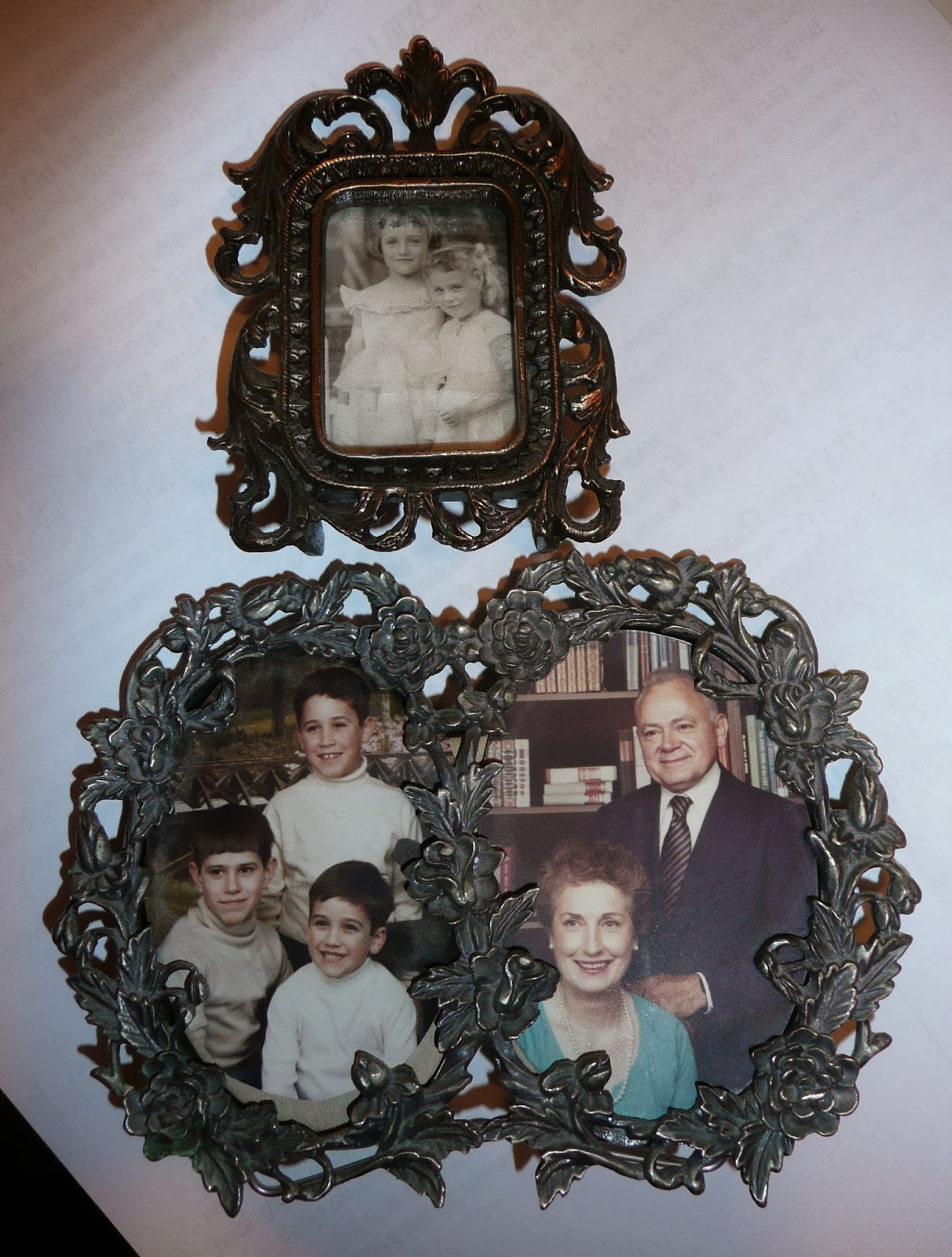
upper frame - my sister and I
ages 7 and five
lower frame my sons and
my parents 1984

In what followed my father's death the beautiful objects, so lovingly, artistically arranged and maintained were propelled from their set order or place; off into the unknown universe; a diaspora of all that was their life. What had been an enduringly cohesive whole atomized, exploded, fractured into shards.
 
Before it all went beyond reach I grabbed at some of the shards, little precious objects that were fixtures in their home and present to me my whole life. A few appear here. There are others: my Dad's slide rules in their leather cases so often seen on his drafting table, the little leather bound boxed chess set no bigger than a small paperback book which he carried with him to the Pacific in WWII and brought back in a duffle crammed with every letter he had received from my mother, a pocket knife, a watercolor painted by my mother. Each item of little value except to me and perhaps, this is my hope, to my children and grandchildren after me.
 

silver sewing kit box from Italy - 3x4 inches
 
However I find that when I look upon them I mourn the loss of the whole. Each object in their home was placed in artful relationship to others, a grand collection in reflection of their lives. These objects, in isolation from the whole, seem to have lost something. It does come to me that the loss represented in these objects seemingly removed from the ground of their being is only a reflection of my sense of loss, of my having been propelled into a new way of being, a new stage of life. No longer in this world is there anyone who came before me. who remembers before me, who can tell the old stories. I am now the elder and that has been a bit of a shock. I feel the burden of holding the stories and the need to keep sharing them, especially with the little ones so that when they receive the gift of these precious objects they will know something of their meaning to those who loved them so dearly.

Helmut Eric Nimke with family
March, 2013
 

Sunday, September 08, 2013

Another Boomer Challenge

Invitation envelope seal


Invitation cover - Senate House, Kingston - Wedding location

All art the creation of Matthew Pleva
 
So, as it turns out we Baby Boomers are also, on occasion, referred to as "the sandwich generation"; the generation living well beyond middle age with the generation before them and their own 'begats' simultaneously calling for attention. The lives of many of my friends are bracketed by elderly parents on one side and on the other by young adult children who, even if independent and making their way through the world, require attention, if only to keep those wonderful relationships going.
 
Sometimes it is all a bit much and the tugs from opposite poles a bit uncomfortable. I continue to ride out a demanding time as I look after my 89 year old mother who is in an assisted living facility. But in my case, at this time the tug from the other end is just to share in the joy of lives moving on. Next month my middle son Matthew, will wed Heidi with whom he has lived for about five years. They've resisted the idea of legal marriage for so long and admit that they have finally surrendered, will put aside their resistance and take the plunge.


Thus the wedding invitation pictured here. And this is another feature of the sandwich generation; adjustment to an entirely different way of doing things so different that one can wonder, "Didn't I raise this child?" Well I raised one creative child who found a beautiful kindred soul. They love each other and I love them.
 
Upon full opening - one hears the military theme music from "South Park",
a take-off of the march from "Les Mis"
(Note that the Senate House was burned by the British in 1776)

 
Below are the theme related invitation inserts.


Thursday, February 28, 2013

Remembrance of Things Past - A Night at the Opera


Two tickets for performance of "La Boheme" On February 9, 1944
at the Metropolitan Opera House, New York City


Terra cotta frieze from the façade of the old Metropolitan Opera House
mounted in fireplace
 

Since the second week in January I have been living with my father who will be 92 years old on May 25th. My father is many things: husband for almost 70 years, father of two daughters, native of Germany, US Air Corps veteran of WWII, retired professional engineer with credentials both in mechanical and civil engineering, and former member of the governing board of the community where he and my mother have lived in the house he designed since 1968.

But his curriculum vitae would include so much more. I have described him as a Renaissance man: builder of boats and ham radio equipment, lover of history ancient and modern, devotee of the arts especially classical music and opera, patriotic and interested citizen and supporter of the best interests of the country which welcomed him at the age of eight and provided him with the finest of educations at no cost at The City College of New York of CUNY.

My parents' home is filled with collections of material connected with each of my Dad's areas of professional or personal expertise as well as my mother's collections reflecting her interests in needlework, painting and gourmet cooking. Since Mom is living in an assisted living facility receiving care appropriate to her stage of dementia and Dad is receiving my care and the wonderful care of Hospice I am able, at every free moment, to begin the process of going through it all, weeding out, assigning destinations for a great deal and often rewarded by the discovery of a treasure.
 
One of our family stories is attached to the ticket stubs shown here. I found these stubs resting at the bottom of a small drawer in my mother's bedroom desk. On February 9, 1944 my father was on leave from the Army Air Corps before going to places like Meridian, Mississippi with his young wife. He thought to give my mother and her aunt a treat by taking them to the opera. He was to pick them up at their place of work, the fashion house of Nettie Rosenstine on 7th Avenue. Rosenstine was a famous designer for whom my mother worked as one of a number of sketchers in the design department while my aunt worked with a group of accomplished needlewomen who were sample makers, creators of the first sample of a new design. Upon his arrival at the assigned location my father found himself fairly run over by a bevy of scantily clad models. He said it was a surprise but not hard to take.
 
Arriving at the opera house Dad went to the box office to buy three tickets. He was told that tickets for that performance had been set aside by season ticket holders for the exclusive use of GIs. The tickets he received were for the center box in the Diamond Horseshoe (first row of boxes) held by the Astor family. My aunt, an opera lover who had sat in the balcony for many Met performances could not have been more delighted or impressed.
 
Years later, when the Met's old house was being demolished after the company's move to Lincoln Center, my father purchased the frieze which appears above.  The fireplace for their new home would be designed around it. Another treasured item in search of a new home.                                            

Monday, December 31, 2012

Greeting the New Year of 2013


Roman Missal Page Decoration
Created by Brother Max Schmalzl, CSsR
1850 - 1930


HAPPY and BLESSED
NEW YEAR to ALL
on this
Solemnity of the Mother of God
 
 
Illustrations of the various titles for Jesus (Root of Jesse, Morning Star, Key of David, Alpha and Omega) adorn the corners of this piece so rich in detail and buzzing with activity. Some of your image will be blocked but this had to be enlarged as much as possible to show the detail. Fortunately the great work of this modest German Redemptorist Brother is enjoying a renaissance.
 
 
Some changes are coming to this blog with the arrvial of the New Year. Stay tuned!


Wednesday, December 12, 2012

Dioramas in Miniature

Independence Hall, Philadelphia, PA - 1.25 inches across
Matthew Pleva


Heidi Abrams and Matthew Pleva
 
Artist Genes

Prevail

From

Grandmother
 
to Grandson


My mother Matilda Nimke is an artist. As a teen in    the 1940s she opted to attend a special commercial high school in Manhattan, the School of Industrial Arts. The program was designed to train artists and craftspeople whose skills would be an important resource for the businesses on 7th Avenue, the garment district of New York. My mother, inspired by her aunt and many friends who worked for designers, chose to pursue fashion design. By 1947 she was the mother of two and that dream faded away. Beginning in the 1963 Mom began painting again and taking classes, especially at the Brooklyn Museum.


Here are some of my mother's paintings. She discovered her gift for watercolor, much to our delight. Today Mom has put the paint brushes aside. I used to tell her to "clean less and paint more". Fortunately she did paint more. Her grandchildren and great-grandchildren will all eventually enjoy looking at her work in their own homes.

In turn I have dabbled here and there. A bit of drawing and painting was overwhelmed by work in the needle arts. Mom exposed us early to all kinds of art and craft media as well as needlework. Many family members worked in the garment industry; all the women sewed; many did knitting and crocheting of the most elaborate kind.


Now it is my son Matthew (the middle one) who is making his way through the art world with more training than his grandmother or mother every had (BFA - SUNY Purchase). He also has much more imagination than most people. Here is a Photobucket Slide Show  of his most recent gallery show at the Art Riot, the establishment that he and his lovely lady Heidi Abrams (and greatest support) have created on John Street, uptown Kingston, NY.
 
Scenes of Kingston
 top - home
middle - Old Dutch Church
foreground - Henry Hudson's Half Moon 


Wednesday, November 21, 2012


Knitted in Your Mother’s Womb

What mortal hand can e're untie
The filial band that knits me to thy rugged strand.   
Sir Walter Scott 1771-1832 – The Lay of the Last Minstrel


Little Owl cardigan for my grandniece
Is it the Book of Psalms or the Book of Wisdom in which we hear that our creator God knew us as we were being knit in our mother’s womb? Could it be that our God is a knitter? That may be more than a bit of a stretch. But knitting is an apt image of the work of creation – a slow and deliberate effort of the benign artist. Someone once said that “The act of creating is all we know of God.” When we create something with our own hands, out of our own imagination, from our own design – written, painted, sculpted, woven, knitted, embroidered, molded, carved, sewn, constructed, drawn, etc. – we experience the vital creative function of the divine.
Silk and wool vareigated lace weight
A few weeks ago I posted some pictures of knitted lace shawls, the making of which has become a passion of mine. That some of my life be dedicated to the creation of something beautiful, whatever the art form, is a necessity for me. Handwork of many kinds especially knitting, quilting, and spinning fit as hand to glove into contemplative life. This is true of any effort at artistic creation. Designing a garden, arranging flowers, as  well as any and all of the visual and creative arts fit the life of prayer and serve it well. Each is a creative, slow, repetitious, contemplative process that can remove us from the noise and distraction of 21st century life in the first world.

Handspun merino wool lace weight knit-on edge
Needlework is something practically bred in the bone of my history. I was urrounded by a family and a neighborhood dominated by talk of New York City’s garment industry. Sewing machine operators, sample and pattern makers, pressers were joined by my mother in her youthful pursuit of fashion design. My father would often survey his daughters gathered with their mother around the dinette table all absorbed in needle work of one kind or another and declare, “Another meeting the of the Idleness is Sin Club!” I do not remember being taught to crochet. I just seemed to have always been able to do it beginning with mini-items of clothing for Ginny Dolls of the 1950s. My mother started us in embroidery by handing us a scrap of white fabric, probably torn from an old sheet and stretched in a hoop, along with a sewing needle carrying colorful thread. She would say, “Draw a picture.” Thus we learned how to make a friend of that pesky needle.

Variegated wool sock weight with crochet edge
My mother introduced me to knitting when I was about ten years old but I was significantly helped along by a neighborhood friend a couple of years older who at least knew the knit and purl stitches. Mom’s help was limited. She could not follow written directions and made all of her gorgeous boucle tops via step-by step instructions at the local yarn store. I remember a white blouse with evenly spaced black jet hanging beads and another with a checkerboard motif highlighting the scoop neck. Every Brooklyn neighborhood had at least one yarn emporium in which a sorority of knitters filled chairs pushed up against walls bearing floor to ceiling shelves of  woolen fiber in a riot of color. In high school I decided to knit a real sweater for the first time. Mom was not encouraging and warned that she could not help me with directions. But the older sister of a friend promised I could do it under her guidance. The rest is history. Most of the people I have loved in my life received products of hasty needles performing in the rythym of the continental style of western European knitting.
I tell friends that if I sit in front of the TV without any needlework in my hands they can safely assume that I am dead tired. Years ago, when I began to find myself at many and various meetings, especially evening meetings following a long day of work, knitting came along to keep me attentive and awake. This seems counter intuitive but knitters universally report this phenomenon. We always have a simple project put aside as ‘meeting knitting”. This knitting also helps me to keep my mouth shut. There is also some truth in what Stephanie Pearl-McPhee, the author of At Knit’s End: Meditations for Women Who Knit Too Much, declares: “...the number one reason knitters knit is because they are so smart that they need knitting to make boring things interesting. Knitters are so compellingly clever that they simply can't tolerate boredom. It takes more to engage and entertain this kind of human, and they need an outlet or they get into trouble… knitters just can't watch TV without doing something else. Knitters just can't wait in line, knitters just can't sit waiting at the doctor's office. Knitters need knitting to add a layer of interest in other, less constructive ways.”

Natural handspun lace weight
Having tired of sweaters, hats, socks, Afghans, plain shawls, and baby attire I tried lace knitting a few years ago. I failed abysmally when following written directions and was told, “You just must learn to read charts.” It is consoling that at my age I could, with discipline and attention, pick up a new skill. So now I am enchanted by knitted lace. The treasures of antique patterns from European countries are being published, particularly those of the British Isles and Estonia. Yes, lace is knitted. What we call Belgian lace is not knitted. It is woven with intertwining threads each one on its own bobbin. But while women of the Low Countries and France were producing this lace, women in Spain and Ireland were creating wedding ring shawls, lace knitted in such fine yarn that the entire thickness of a shawl could be gathered and run through a wedding ring. Interestingly the history of knitting reveals that it probably originated in the Middle East and that Muslims brought the craft to Europe around the 10th century.
Today knitting has enjoyed a great revival, especially in its appeal to the young, and not just women. Taught one of my own sons how to knit as we enjoyed a pre-concert picnic on the great lawn of Tanglewood, the Bershires summer home of the Boston Symphony, in Massachusetts. Later he said, “Mom, now I know why you love doing this.”

Links:
http:///www.ravelry.com
(everything knitters want to know about knitting and a zillion patterns)
http://www.knit-a-square.com/history-of-knitting.html  (history)

Book:    No Idle Hands: The Social History of Knitting by Anne L. MacDonald


Sunday, September 09, 2012

Quilters Guild Celebrates

Wiltwyck Quilters Guild
Celebrates
35th Anniversary
 
 
Thirty-five years ago I participated in the founding of a guild of quilters. It was born out of the effort to produce a pictorial quilt honoring the history and culture of our county in honor of the bi-centennial celebration of our country. Yesterday the Wiltwyck Quilters Guild enjoyed an anniversary luncheon meeting. It was my privilege of offer the following remarks. Over 100 women attended and a wonderful time was had by all.


          In 1976, in late winter and in early spring, traditional quilting bee season, four to ten women at a time gathered around a large frame dominating the living room of the Kingston home of Ruth Culver. We marked, threaded needles, thimbled them through all three layers of the stretched quilt, buried our knots (if there were any) and we shared stories. I have been told that you would appreciate hearing the Guild story.  Much will be familiar to my peers here and I beg their forgiveness for any failure of my memory. That 1976 quilting bee, women working and creating, united in a mission to mark the bi-centennial of our country, is just part of the story.
It all began with Ruth Culver for whom quilting was not a resurrected historical craft but an art born of necessity, a skill bred in the bone and coaxed into day light by women who had gone before. Like women in the dust-filled Oklahoma mud soddies of the 19th and early 20th centuries, they made quilts so their families wouldn’t freeze and made them as beautiful as possible so they wouldn’t go mad. This sensibility was in Ruth’s Appalachian heritage DNA.
That heritage morphed into quilting courses at Ulster County Community College in the 1970s. With the coming of the nation’s bicentennial a dream was born – a county quilt presenting a pictorial history of the place and its culture. From the ranks of friends and students Ruth gathered 42 women ranging in age from 18 to 78 and invited them to an initial planning meeting on a windy February night in 1975. Each of us has our ‘how I got started with the Guild’ story. After taking a class with Ruth this meeting is where my story would begin.
After growing up in Bensonhurst, Brooklyn, I’d married and lived in Connecticut before moving to Kingston in 1974. Surrounded in childhood by garment workers, knitters and embroiderers, I’d always had a needle in my hand. But I ignored the thimble. Such a nuisance! My Aunt predicted that I would never be a real seamstress until I’d made friends with my thimble. That friendship was to be cemented by an introduction to quilting. Ruth Culver is the second person I met upon moving into our house in her uptown Kingston neighborhood The rest is history, thimble and all.
The organizational meeting that cold winter night was my first outing less than a month after a Cesarean delivery and with a nursing baby in tow. I nearly fainted after running across the windy parking lot and up the stairs of Vanderlyn hall. Collapsed in a chair and did some Lamaze breathing and was ready for business.

 
I do not remember precisely what was decided at that particular meeting. But I do know that we were fired up by Ruth’s enthusiasm and her ‘no obstacle too great’ attitude. We talked about eventual size, what blocks might depict, materials, timeline for production, work sessions were we would help each other solve design problems and swop fabric to get just the right tone and texture for the pictures we were going to paint with fabric. We dreamed too of mounting the quilt in a show incorporating other quilted pieces. All of this eventually came to pass. The nursing baby eventually played under the frame as we quilted in Ruth’s living room. There were non-stop bees composed of rotating quilters, one leaving and another taking her place before the seat had time to cool. There was not a single topic of interest to women that was not discussed around that quilting frame: children, husbands, discipline of both, parents, childhood memories, recipes, home remedies for illness, networking of every kind. Our youngest quilter, Kathy Baxter Krayewski, was only 18 and she got some education. We were teachers, artists, homemakers, nurses, business women, secretaries, waitresses, retirees, college students, young mothers and grandmothers from every ethnic, racial and religious background who became friends in the effort to create something beautiful, a tribute to our history and culture, emblematic of our pride in the bicentennial celebration of our country. The Guild has in slide form a photo of each block of the quilt. My father came with a tripod and his Rolleiflex to immortalize each block. Those slides have now been digitized. They were used in presentations made to 4th grade classes in schools throughout the country to augment local history studies during the period of the bi-centennial celebration. 
The dream of a show featuring the quilt came to pass in late spring of 1976 in the art gallery of the college. We were so pumped up after that show and wanted a place to put our energies, a way in which we could maintain the bonds formed between us. We also knew that working together spurred us in creativity.
Early in the spring of 1977, to express our gratitude, the 42 bicentennial quilters presented Ruth with an album quilt at a luncheon in her honor. We all knew that we did not want it to end and discussed at table how we would proceed to create a permanent group. We know of the Embroiderer’s Guild and thought we could promote and educate others while stimulating our own creativity and skill development. In conversation various names were tossed around.  Ulster County Quilters’ Guild, Kingston Quilters’ Guild were rejected In our research for the historical blocks of the bicentennial quilt we had learned that the early Dutch name for the area was Wiltwyck (wild wood) and I suggested we us this name. Wiltwyck Quilters’ Guild has a nice ring to it. In the summer of that year Ruth, Polly Briwa, myself and one other woman whose name eludes me, met a number of times to write the organization by-laws.  We began regular meetings at the college in the fall of 1977 and elected Ruth as our first president.
Aelittle side story his called for here. Polly Briwa was a larger than life personality, a sort of ‘Auntie Mame’ figure dedicated to her enthusiasms. She and her IMBer husband lived in a restored old stone Dutch house on Sawkill Road. She became a prolific quilter but she was also a chain smoker and died much too early. After moving to Glens Falls she became active in the guild there. Upon her death, her husband began sponsoring a cash award for the finest log cabin pattern quilt at every guild show in Glens Falls.
Looking back, it seems we worked at brake neck speed, but we were younger then. Most of us had families and/or other day jobs, were creating fabulous quilts at home, meeting regularly as a fledgling guild formalizing its structure AND mounting our first major show in June of 1978. This last could not have been accomplished without the visionary leadership of Ruth Culver and the considerable tech support of Ulster County Community College under President Donald Katt. The college provided the venue, insurance, printing and security for a show that ran for two weeks. Since many of you, I am sure, have been involved in show presentation there is no need to list the complications but for others I must. Themes, invitational quilts, raffle quilt, judges, prizes, staffing, vendors, demonstrations and workshops were all put into place. How pleased we were to present the profits earned to the college scholarship fund.
So much for history. I cannot close without speaking of how the Guild achieved its primary purpose which is to promote the art of quilting and continue skill development in its membership and become a sorority of quilters; women with purpose and creativity . At a time when the commercial sector had not yet responded to the bicentennial boom in quilting we were inventive. Before clear grid rulers we used metal and plexi-glass scraps purchased at places like what was then P&D Surplus on the Strand in Kingston. We had our husbands cut them into measured strips. Before rotary cutters we made pattern pieces with Shrinkydink plastic stolen from our kids (smooth on one side and matte finish on the other. Kids drew on it, cut out designs and baked them in the oven until shrunk. And for the hand quilters among us we do not fail to remember when Elaine Blyth, charter member from New Paltz, reported quilting her prize winning navy blue and white patchwork beauty entirely on a lap hoop. This was the equivalent at the time of moving from a Commodore 64 computer to and Apple PC or today stepping up from a simple one purpose cell phone to an I-Phone. We simply couldn’t believe it. “Are you sure you won’t have gaps and ripples?” we asked. Elaine reassured, “Just baste the hell out of it in a frame and quilt from the center out. She was right and we were liberated.”
          Thank you for the part each of you has played in allowing the Guild to continue to achieve its purpose and flourish. A mark of your success is the number of members who have been admitted to the Catskill Quilters Hall of Fame over the years. Other signs are the continuing string of workshop offerings and the presentation of bi-annual shows. You are to be congratulated.
On a personal note, although I withdrew from the Guild in 2000, the education in this art form and the influence of countless creative, generous and inspiring women stayed with me. I continue to quilt and have become more adventurous in my efforts. For that I am grateful. But most of all, I am grateful for the memories, the wisdom, camaraderie, listening ears, and creative example of women. Some things about quilting never change, except that now men are sharing the wealth.
In the mid-1980s when I was inducted into the Catskill Mountain Quilters Hall of Fame, I closed my words of gratitude with this citation from the Book of Psalms. With your kind permission I will use them here:
May the favor of God be upon us,
and prosper the work of our hands,
O prosper the work of our hands.
          Best wishes for your upcoming show. Thank you.


Friday, January 13, 2012

Mystery of the Hummel Figurine

On December 27, 2011 I posted a piece about our Redemptoristine tradition of displaying the infant Jesus in many places in the monastery - some as big as a baby doll and some as small as this 5" Hummel figure. I told the story of how I received it as a gift over 50 years ago and have long wondered about its origin and value. Someone else, googling around to find out about their similiar baby  Jesus was brought to this blog and sent the following:

I was searching "google" for information about my bisque Hummel Infant Jesus and your Blog came up.  Because you told how you acquired your Infant Jesus, I'll tell you how I acquired mine.

My Hummel is exactly like yours, but mine is the "large" figurine -- it's about 11.5" long.  I bought it in the fall of 1953 through my German teacher at Mundelein College, Chicago, a darling little German nun (BVM) whose name I now forget, but it probably is in my "year book", if I could ever locate that after all this time.   She was well acquainted with Berta Hummel's religious order and had an arrangement to purchase the "Infants" at cost -- both the small one ($3 I think) and the large one ($6, as I remember).  Most of my classmates who bought one, bought the small one.  But I (and possibly one other student) bought the large one -- mine was my Christmas gift to my Mother -- so I needed to be generous.  She displayed it with her Christmas decorations every year.

Following my mother's death about 6 years later, I reclaimed the Infant Jesus and have displayed it with my Christmas decorations since.  It has survived the move from Chicago to Iowa to California, earthquakes, and 5 kids.  I used to hang it above the fireplace, but now I display it on the mantel in a woven oval basket filled with gold-colored garlands, rolled up, to make a "bed of straw." 

My figurine has the name "Hummel," and the "v" and "bee" stamped on it, indicating that it was made between 1950 and 1955.  It also has the numerals: 78/6 on the back -- I have no idea what this means.  It's the same light beige coloring, and has the two holes in back, as yours.  I have a memory (which I no longer trust) that my German teacher said that Berta Hummel never made any figurines, except this one of the Infant Jesus -- as all her other works were drawings (and the typical figurines were made by other artists, based on her drawings).  The Infant Jesus figurines, which you and I have, are (supposedly) made from molds of the original work of Berta Hummel.

Many thanks,

Also, I have no idea of the value of your Infant Jesus, or mine.  My one "google" search was fruitless in this regard.  But, I know that mine is as "priceless" to me as yours is to you.

Thank you for your Blog, and wishing you God's blessings in this New Year.

NCV

This correspondence got me searching again and came up with this. Here's the link:
www.tace.com/i/35663.html I found a complete description of my small Jesus and a perfect picture. It was made between 1952-1959. Unfortuantely no value was given because the item was sold off line. 

Perhaps this bit of research and exchange of memories will excite those who collect Hummels and prompt them to to share stories and information.


Tuesday, December 27, 2011

Memories of Christmas

Chapel Infant Jesus 2011
Hummel Bisque

 
Since the days of our foundress, Venerable Maria Celeste Crostarosa, there has been a Christmas tradition in our Order of displaying a large baby Jesus figure in a cradle. Her monastery in Foggia, Italy has an infant Jesus figure dressed in clothes that are said to have been made by her own hands.  We continue that tradition and have this Infant Jesus under our tree. This Bambino is larger than most baby dolls, at least two feet in length. But the infant above is much smaller and brings it own story. This year it rests on a small round-topped table placed in front of the ambo in our chapel.

The little baby Jesus figurine is about five inches in length. It has been in my possession for fifty years and followed me to the monastery. It was a gift from a Sister of St. Joseph of Brentwood, NY, Sr. Mary Corita Hawthorn, CSJ. I was a public school girl who attended her 8th grade Confraternity of Christian Doctrine (aka CCD) class on Wednesday afternoons during 'released time' from public school. Yes, we were permitted to leave school at 2pm Wednesday afternoons to walk to the local Catholic school, if our parents wished it, for religious instuction. Sister and I struck up a frienship that lasted until 2010 when she passed on to her great reward. I think I was a real curiosity to her because even though the product of public education and non-church-going parents, I passed the exams for admission into the finest of Brooklyn Catholic high schools for girls, a flagship high school of her congregation. Some time during my high school years she presented me with this baby Jesus as a Christmas gift.

Being half German I fully appreciated the artistry and value of this Hummel figurine. On the back of the figure the Hummel name has been molded into the bisque. There is the familiar Hummel logo of the "vee" with the bumble bee above it and the word "Germany" stamped in ink on the back also. Unlike most other Hummel figures this one is not multi-colored but very subdued in light brown and biege. The back also has two holes which would allow for the figure to be hung on a wall.

I remember that it took me a few years of prowling around the post-Christmas sales in New York City department stores to find a cradle to fit this babe. This little one, just perfect in its construction of twigs delicately nailed together, has been carefully re-glued a number of times. But it survives.

These last few days I have searched the internet to find the market value of this piece. None of the Hummel price lists I have found included this exact piece. Maybe someone out there will know more about this. No matter what monetary value may be revealed, this Bambino is priceless to me. It speaks of Jesus in such a sweet voice and speaks of an old and dear friend who reached out to a student to encourage, to reassure and to teach the faith.  


Sunday, December 04, 2011

Prepare the Way of the Lord

Jesse Tree
Frater Max Schmalzl, CSsR
1850 - 1930
Second Sunday of Advent

A voice cries out in the wilderness,
"Prepare the way of the Lord." In what direction do our preparations move forward? Do they keep us on the surface, just floating on a choppy sea pushing us from one chore after another, from item to another on an ever growing list of 'to dos'? Here is a prayer from Henri Nouwen which may add a couple of stabilizing pontoons to your  fragile vessel bobbing its way through the season.

Lord Jesus,
     Master of both the light and the darkness,
       send your Holy Spirit upon our preaprations
       for Christmas.
We who have so much to do
      seek quiet spaces to hear your voice each day.
We who are anxious over many things
      look forward to your coming among us.
We who are blessed in so many ways
      long for the complete joy of your kingsdom.
We whose hearts are heavy
      seek the joy of your presence.
We are your people, walking in darkness,
      yet seeking the light.
To you we say, "Come, Lord Jesus!"
      Amen.
                Henri J.M. Nouwen 1932-1996